






The Bank of Ghana has revoked the electronic money licence of Zeepay Ghana Ltd, ending, at least for now, the company’s ability to issue mobile wallet balances to customers, agents and merchants across the country.
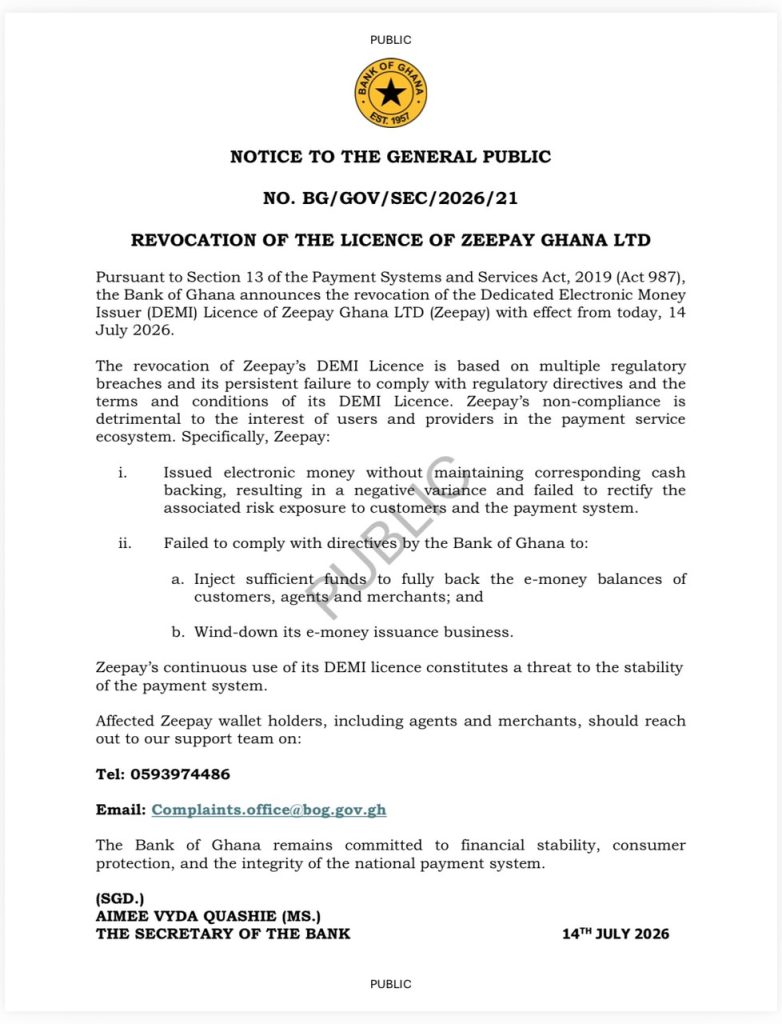
In a notice dated July 14, 2026, the central bank said it was cancelling Zeepay’s Dedicated Electronic Money Issuer (DEMI) licence under Section 13 of the Payment Systems and Services Act, 2019 (Act 987), effective immediately.
The regulator cited “multiple regulatory breaches” and what it called Zeepay’s “persistent failure to comply with regulatory directives and the terms and conditions of its DEMI Licence.”
What the Central Bank Says Went Wrong
The notice, signed by Bank of Ghana Secretary Aimee Vyda Quashie, lays out two core allegations. First, that Zeepay issued electronic money without maintaining the corresponding cash backing required of e-money issuers — a shortfall the notice describes as a “negative variance” that Zeepay failed to correct despite the exposure it created for customers and the payment system.
Second, the bank said Zeepay failed to comply with two specific directives: to inject sufficient funds to fully back e-money balances held by customers, agents and merchants, and to wind down its e-money issuance business altogether. The notice does not say when those directives were first issued or how long Zeepay had to comply, leaving a gap in the public timeline of the enforcement action.
The central bank concluded that Zeepay’s continued use of the licence “constitutes a threat to the stability of the payment system” — language considerably sharper than the bank used in 2023, when it briefly suspended Zeepay’s separate forex licence over exchange-rate violations, a dispute the company resolved within weeks.
A Company Already Under Siege
Zeepay has spent much of 2026 fighting on several fronts at once. In February, creditor Obsidian Achernar Ltd filed a petition at Ghana’s High Court Commercial Division seeking to wind up Zeepay over an unpaid $1.22 million debt tied to a 2024 foreign exchange and working capital agreement. That case is still pending.
More consequential still was a ruling this month in which the High Court’s Commercial Division ordered Zeepay and its chief executive, Andrew Takyi-Appiah, to personally pay more than $11.6 million to a customer whose funds — deposited for onward transfer — were never sent.
The court found some of that money had gone into Takyi-Appiah’s personal mobile money wallet, and it rejected an attempt by Zeepay’s lawyers to remove him as a defendant.
Zeepay’s troubles have also crossed borders. In May, the Central Bank of Barbados suspended the licence of Zeepay subsidiary Zeemoney (Barbados) Limited over concerns about financial condition, governance and operational continuity. Rather than resolve those concerns, the subsidiary applied to voluntarily wind down its four Barbados branches, leaving customers there without a clear timeline for recovering funds held in their wallets.
Taken together, the sequence — a Caribbean subsidiary’s collapse, a nine-figure personal judgment against the CEO, an active insolvency petition, and now a revoked e-money licence at home — represents the most serious crisis in the eleven-year history of a company that once marketed itself as one of Africa’s fastest-growing remittance and mobile money platforms.
What Happens to Wallet Holders
The Bank of Ghana’s notice directs affected Zeepay wallet holders, including agents and merchants, to contact its support team by phone or email. But the notice does not spell out a recovery process, a timeline, or how much of the “negative variance” between issued e-money and actual cash backing customers might be exposed to.
Those details — arguably the ones wallet holders most need — are not yet public.
It’s also unclear how the licence revocation intersects with the pending winding-up petition and the $11.6 million judgment against Zeepay and Takyi-Appiah. A company facing insolvency proceedings that has now also lost its primary e-money licence has few paths left to generate the revenue that might satisfy creditors or fund customer repayments.
Zeepay has not issued a public statement in response to the notice. The Bank of Ghana’s revocation is also silent on whether Zeepay’s other licences — including its remittance and mobile money termination business — remain intact, or whether more of its Ghana operations could be scaled back or shut down entirely.