





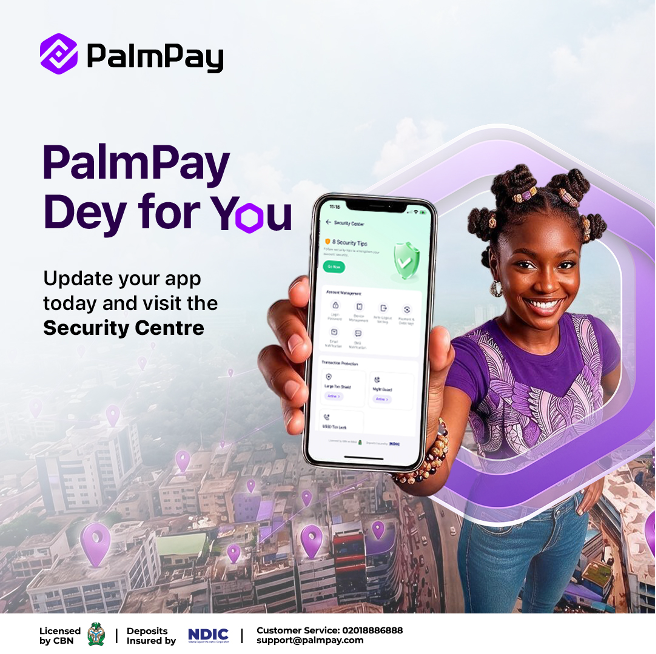
PalmPay has launched a customer-facing campaign, “PalmPay Dey For You,” aimed at reassuring Nigerian users about the safety of their money as scrutiny of digital financial platforms intensifies.
The campaign centers on PalmPay’s regulatory standing and a suite of in-app security tools, including a feature that lets customers restrict account access to trusted locations. It arrives as the company, one of Nigeria’s largest fintech platforms by user count, faces a familiar tension: broad adoption paired with persistent complaints about customer support and dispute resolution.
What PalmPay Is Announcing
The campaign promotes PalmPay’s Security Center, a hub of account-protection tools. Location Guard allows users to designate up to six trusted locations, flagging activity from unfamiliar places. NightGuard adds protection during set hours.
Customers who lose phone or card access can lock their accounts by dialing short codes — 86112# for accounts, 8617*5# for cards.
PalmPay has also promoted its in-app Dispute Page, giving customers a direct channel to file and track transaction complaints.
Chika Nwosu, PalmPay Nigeria’s managing director, framed the push as a matter of institutional trust. “Customers need to know that the institution they rely on is regulated, secure, dependable, and available when they need it,” Nwosu said in a statement.
The Regulatory Backdrop
PalmPay operates in Nigeria as a Central Bank-licensed mobile money operator, with eligible deposits covered by the Nigeria Deposit Insurance Corporation. That licensing status has strengthened recently: the CBN upgraded PalmPay to a full national operating license in January 2026, the highest tier available to a mobile money operator in the country.
That upgrade matters because it follows years of public uncertainty about fintech oversight in Nigeria. In 2023, the CBN was forced to publicly deny reports that it had suspended PalmPay and rival OPay over fraud concerns.
In 2024, the central bank temporarily barred PalmPay and several other major fintechs — including OPay, Moniepoint and Kuda — from onboarding new customers as part of a broader crackdown on identity verification gaps that fraudsters had exploited. PalmPay responded that year by mandating BVN or NIN verification for all new wallets.
Context Within Nigeria’s Fintech Market
PalmPay’s push for a security-forward narrative is not happening in isolation. Nigeria’s mobile money sector has expanded rapidly, and with it, public anxiety about which platforms are safe to trust with everyday transactions. The CBN’s tightened KYC rules and the 2024 onboarding freeze reflected regulatory concern that platform growth had outpaced fraud controls.
PalmPay’s disclosed funding includes a $100 million Series A round in 2021, part of $140 million in total disclosed funding, and the company has been valued near $1.5 billion. Scale of that kind raises the stakes on reliability: a platform serving millions of daily transactions faces greater exposure when transfers fail or disputes go unresolved, even if the underlying rate of failure is small.
The Bigger Picture
PalmPay’s campaign leans on a genuine and verifiable claim — its regulatory upgrade in January was a real strengthening of oversight, not marketing spin. But “PalmPay Dey For You” packages that regulatory news alongside security tools addressing a narrower problem than the one most reviewers say actually drives distrust: slow dispute resolution, not account breaches.