Nigeria’s July 1 e-invoicing deadline for medium taxpayers is now less than four months away — and Duplo just positioned itself as one of the most complete compliance pipes in the market.
Driving The News
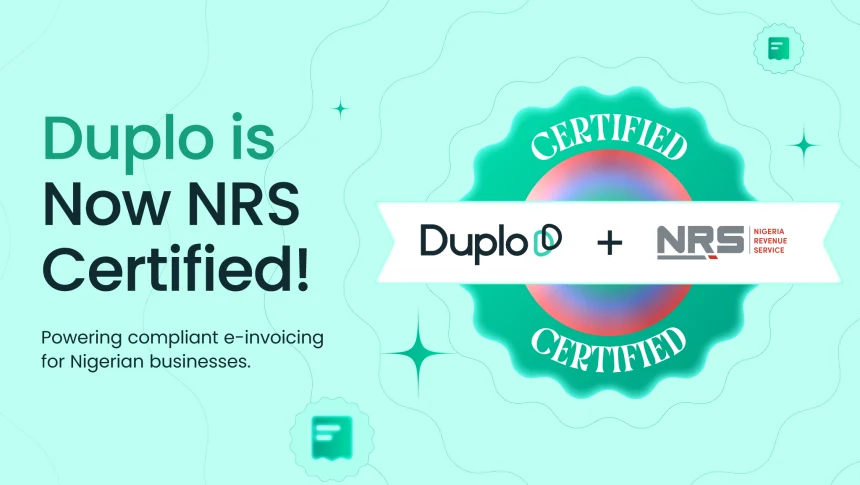
The Nigerian Revenue Service (NRS) granted Duplo, a financial operating system company, both a Systems Integrator (SI) and Access Point Provider (APP) license, making it one of the only fintech platforms in Nigeria accredited to handle the full invoice-to-payment loop under the country’s new Electronic Fiscal System (EFS).
Why it matters
Most e-invoicing providers stop at generation. Duplo’s dual license means businesses can generate NRS-compliant invoices, route them automatically to tax authorities, and settle those payments — all on the same platform.
- Businesses can plug existing ERPs (SAP, Oracle, QuickBooks, Microsoft Dynamics) directly into Duplo to auto-generate and transmit invoices in UBL/XML format.
- Once the NRS validates an invoice, it can be settled and reconciled immediately on the Duplo platform — eliminating the manual reconciliation gap that drives most financial discrepancies at Nigerian firms.
The NRS estimates over ₦500 billion is lost annually to tax leakage tied to manual invoicing and under-reporting. Under the EFS framework, businesses with turnovers above ₦1 billion now face pre-clearance requirements — and non-compliance carries ₦200,000 administrative fines plus 100% tax surcharges on unreported transactions.
What they’re saying
“This isn’t just about compliance; it’s about closing the loop,” said CEO Yele Oyekola. “You don’t scale payment operations by adding headcount — you scale by automating decisions and standardizing the infrastructure.”
Who’s already on the platform: Maersk, DP World, Baobab, Miva Open University, and Eat N’Go are among the companies using Duplo for payment automation.
The big picture: Nigeria’s shift to real-time tax pre-clearance is accelerating a broader enterprise fintech opportunity across Africa — one where compliance infrastructure and payment rails are increasingly the same product.