Ghana’s phone networks drop calls, throttle data, and leave millions of rural residents without meaningful coverage. Everybody knows it.
And for more than two decades, the National Communications Authority (NCA)—the government body charged with fixing exactly this—enforced quality benchmarks written in 2004, when the iPhone didn’t exist and most Ghanaians still relied on 2G.
That changed in February 2026, when the NCA announced its toughest quality-of-service overhaul in the regulator’s 30-year history. Whether it will actually work is a different question.
The new framework, which took immediate effect on February 15, is significant on paper. It slashes the maximum allowable call drop rate from 3% to below 1%, requires mobile operators to hit call connection success rates above 95%, and mandates average data speeds of at least 1 megabit per second across every Metropolitan, Municipal, and District Assembly in the country—not just urban centres.
For the first time, operators are also legally required to extend coverage beyond district capitals to all constituent towns within each district. Fail to comply, and they face sanctions under their licence conditions.
But the market the NCA is now trying to regulate looks almost nothing like the one those 2004 rules were designed for—and not in a good way.
Downward Trend Of A Once Bright Telecom Sector
Ghana’s telecom sector is in structural distress.
The market used to have six competitive firms vying for market share, offering customers deals and promotions to acquire new users.
In 2026, the firms are just down to three: MTN, Telecel, and AT Ghana.
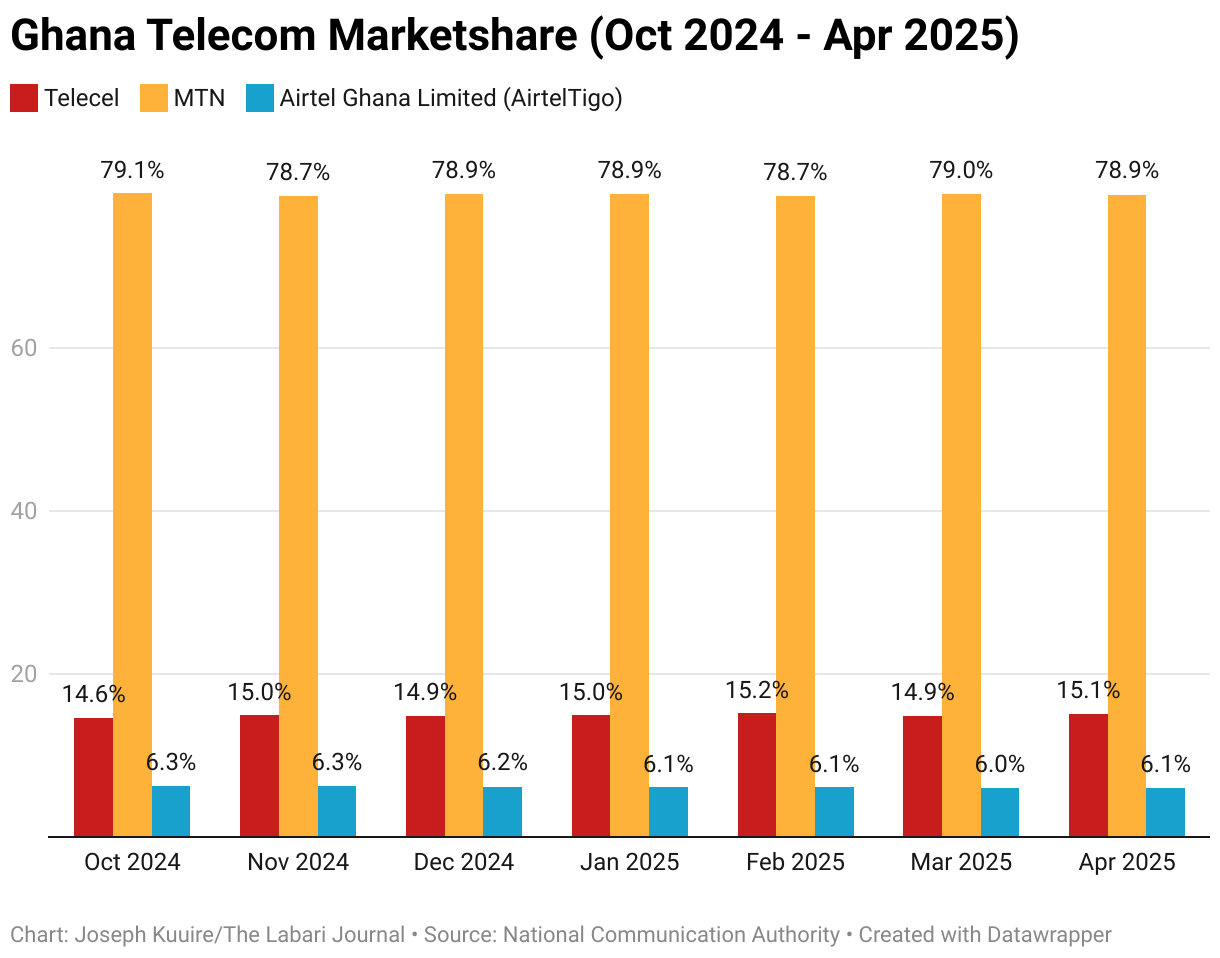
AT Ghana (formerly AirtelTigo, now government-owned) has watched its market share collapse from over 25% in 2018 to roughly 6% today. It owes more than $150 million and would need an estimated $600 million over four years just to return to competitive strength.
Telecel Ghana (formerly Vodafone Ghana) holds a relatively stable second position at around 15%, buoyed by network investment and subscriber growth.
And then there’s MTN, which has quietly expanded from 61% market share in early 2022 to nearly 79% today—a level of dominance that both the NCA and the Communications Ministry have publicly flagged as a potential security and competition risk.
Eyes on the Regulator
The regulator has not been entirely asleep. In 2020, the NCA classified MTN as a Significant Market Power—a designation that subjects the carrier to stricter pricing and conduct requirements. MTN initially challenged that ruling in court before withdrawing its case.
The NCA also introduced technology neutrality policies in 2023 to reduce barriers for smaller operators and has worked with the Ministry on data pricing concerns.
But it can be argued that these have been piecemeal moves in the face of a market consolidating rapidly around one dominant player.
The Ghana Chamber of Telecommunications has pushed back hard. Its CEO, Sylvia Owusu-Ankomah, told Citi Business News that while the industry supports better service, a compliance-only approach “ignores the commercial and structural challenges operators face daily.”
The Chamber’s most pointed argument concerns infrastructure sabotage. Operators recorded more than 5,000 fibre optic cable cuts in 2024 alone, at a cost of roughly $9.2 million. Since the start of 2025, the sector has spent over GH¢90 million repairing damaged infrastructure.
Penalising operators for network downtime caused by third-party vandals or contractors cutting cables, the Chamber argues, is deeply inequitable.
Lack of Investment
There’s also the question of where investment is supposed to come from. With 95% geographic coverage but a staggering 62% usage gap—meaning people who technically have a signal but can’t or don’t use data—the sector’s fundamental challenge isn’t access, it’s affordability and relevance.
Building rural towers in commercially unviable areas without public subsidies is a business model problem the NCA can’t regulate its way out of.
Consumer advocates are less sympathetic to the operators. For years, Ghanaians have borne dropped calls, failed connections, and sluggish data while telecom companies remained among the most profitable businesses in the country’s services sector.
The argument that fines are simply absorbed as operational costs has real force here. Meaningful enforcement would require sanctions scaled to operator turnover rather than fixed penalties, and the public disclosure of district-level performance data so consumers can actually compare providers. Neither exists yet.
As of April 2026, the NCA had not published any compliance data since the new standards took effect, and no operator had publicly disclosed its performance against the revised benchmarks.
The Delays of 5G
Meanwhile, the 5G picture adds another layer of complexity. Ghana’s government announced plans in February 2026 to auction 5G spectrum and scrap an exclusivity arrangement that had given a single infrastructure company, NGIC, a ten-year monopoly on the technology.
As of mid-2025, NGIC had completed only 16 of the 50 required sites in Accra and Kumasi. The government’s stated ambition—70% 5G population coverage by Ghana’s 70th Independence anniversary in 2027—is aggressive.
Thirty years after its founding, the NCA finds itself at an inflection point. The new quality standards signal a genuine shift in regulatory philosophy—from simply ensuring network access exists to demanding that it actually delivers value.
But enforcement credibility will be built or destroyed in the months ahead.
If the NCA fines operators meaningfully, publishes transparent performance data, and pushes through the structural reforms needed to keep competition alive in a market increasingly defined by one dominant player, it will have earned its toughened reputation.
If the new benchmarks become numbers on paper, Ghanaians will have seen this movie before.
The regulator has the rules. Now it needs the will.