
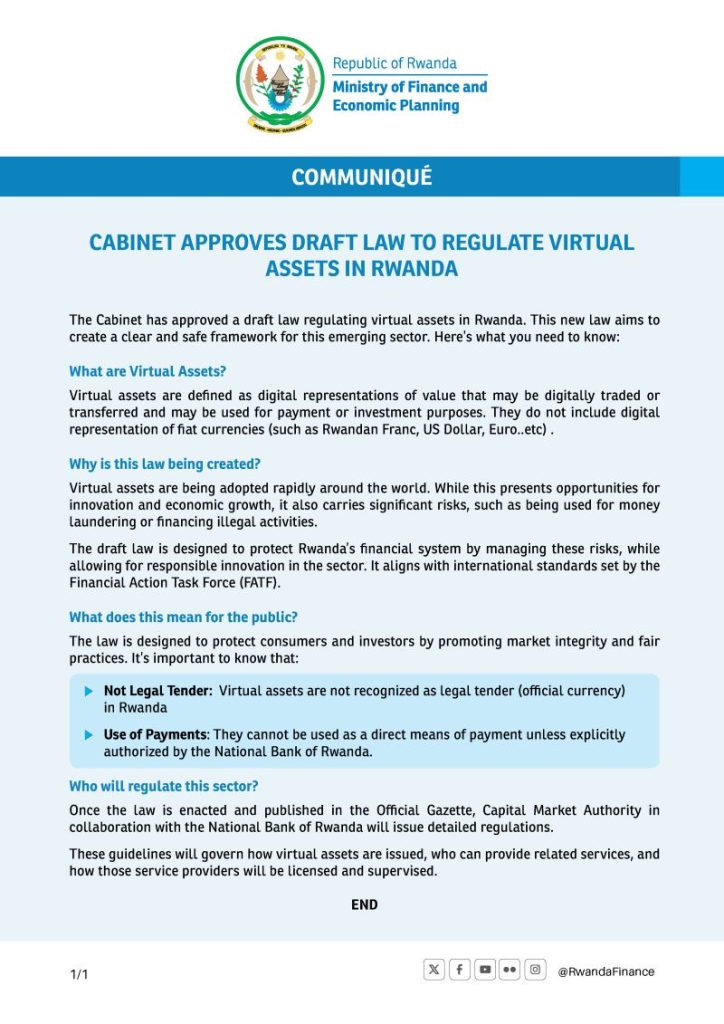
The Rwandan Cabinet has officially greenlit a draft law to regulate virtual assets, signaling a major shift toward bringing cryptocurrencies and digital value into the fold of the country’s formal financial system.
Here’s why this matters and how it will work.
The Big Picture
Rwanda is positioning itself as a balanced fintech hub. By introducing this law, the government aims to embrace the innovation of blockchain technology while building a “firewall” against the financial risks—specifically money laundering and terrorism financing—that often shadow unregulated digital assets.
How it Works
The draft law creates a structured environment for what were previously “gray market” activities.
- Defining the Asset: Virtual assets are categorized as digital representations of value used for trading, payments, or investment. Crucially, they are not the same as digital versions of fiat (like the Rwandan Franc or US Dollar).
- The Regulatory Duo: Once the law hits the Official Gazette, the Capital Market Authority (CMA) and the National Bank of Rwanda (BNR) will take the reins.
- Licensing & Oversight: The agencies will dictate who can issue these assets, who can provide services (like exchanges), and how those providers must be supervised.
The Guardrails for the Public
The government is making one thing very clear: Don’t mistake “regulated” for “legal tender.”
- Not Official Currency: Cryptocurrencies will not be recognized as legal tender in Rwanda.
- Payment Restrictions: You cannot use virtual assets for direct payments unless the National Bank of Rwanda specifically authorizes it.
- Investor Protection: The primary goal is to promote “market integrity,” ensuring that if you invest in this sector, there are fair practices and legal recourse in place.
Why Now?
Rwanda is aligning itself with the Financial Action Task Force (FATF), the global watchdog for financial crimes. As virtual asset adoption accelerates across East Africa, Rwanda wants to ensure its financial system remains “clean” in the eyes of international investors while still allowing for local tech growth.
The bottom line
Rwanda isn’t banning crypto; it’s professionalizing it. By moving from a “wait-and-see” approach to active regulation, the country is betting that a safe framework will attract more legitimate innovation than a lawless one.