The Uganda Communications Commission (CCU) has directed all telecommunications companies and internet service providers to shut down public internet access effective immediately, citing the need to curb “misinformation” and “incitement of violence” during the country’s election period.
The directive, dated January 13, 2026, marks a significant escalation in the government’s control over digital communications as citizens head to the polls.
The Big Picture
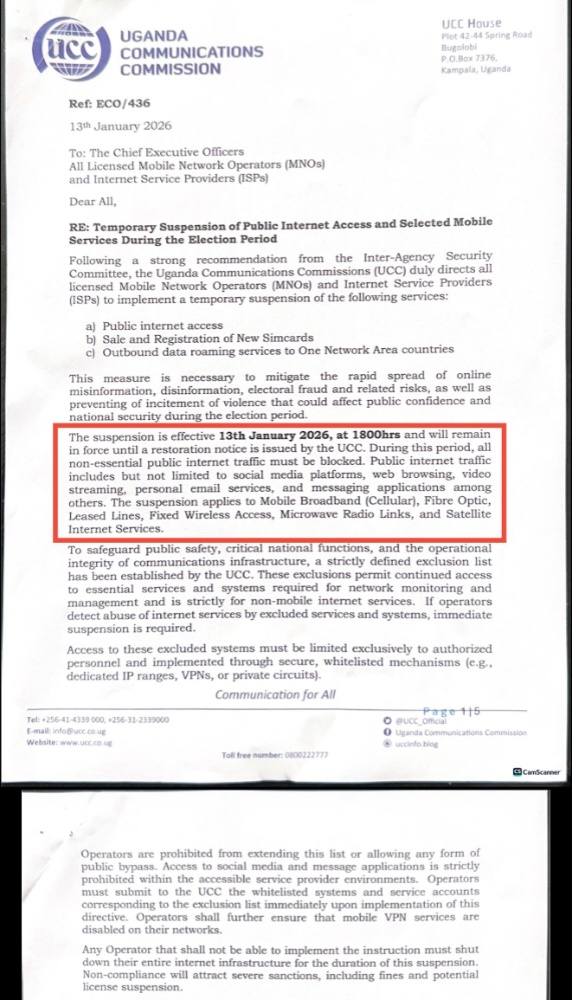
The order targets “non-essential public internet traffic,” specifically naming social media platforms, messaging applications, and video streaming services.
By cutting off these channels, the government effectively silences the primary tools used by opposition groups, independent journalists, and voters for real-time coordination and information sharing.
By the Numbers
- 18:00 hrs: The exact time on January 13, 2026, when the suspension became effective.
- 3 Key Restrictions: The ban covers public internet access, the sale/registration of new SIM cards, and outbound roaming services to “One Network Area” countries.
- 0 Set End Date: The suspension remains in force until a “restoration notice” is issued by the UCC.
Between the Lines
While the UCC justifies the move as a measure for “national security” and to prevent “electoral fraud,” the scope of the shutdown is sweeping. The directive applies to all forms of connectivity, including:
- Mobile Broadband (Cellular)
- Fibre Optic & Leased Lines
- Satellite and Microwave Radio Links
The Catch
There is a “strictly defined exclusion list” for essential services and government functions. However, the UCC warned that any operator providing a “public bypass” or failing to disable mobile VPN services would face severe sanctions, including license revocation.
Why It Matters
Internet shutdowns during African elections have become an increasingly common, yet controversial, tool for incumbent regimes.
Critics argue these “digital blackouts” violate fundamental human rights, transparency, and the integrity of the democratic process by making it impossible to report irregularities or tally results independently.