




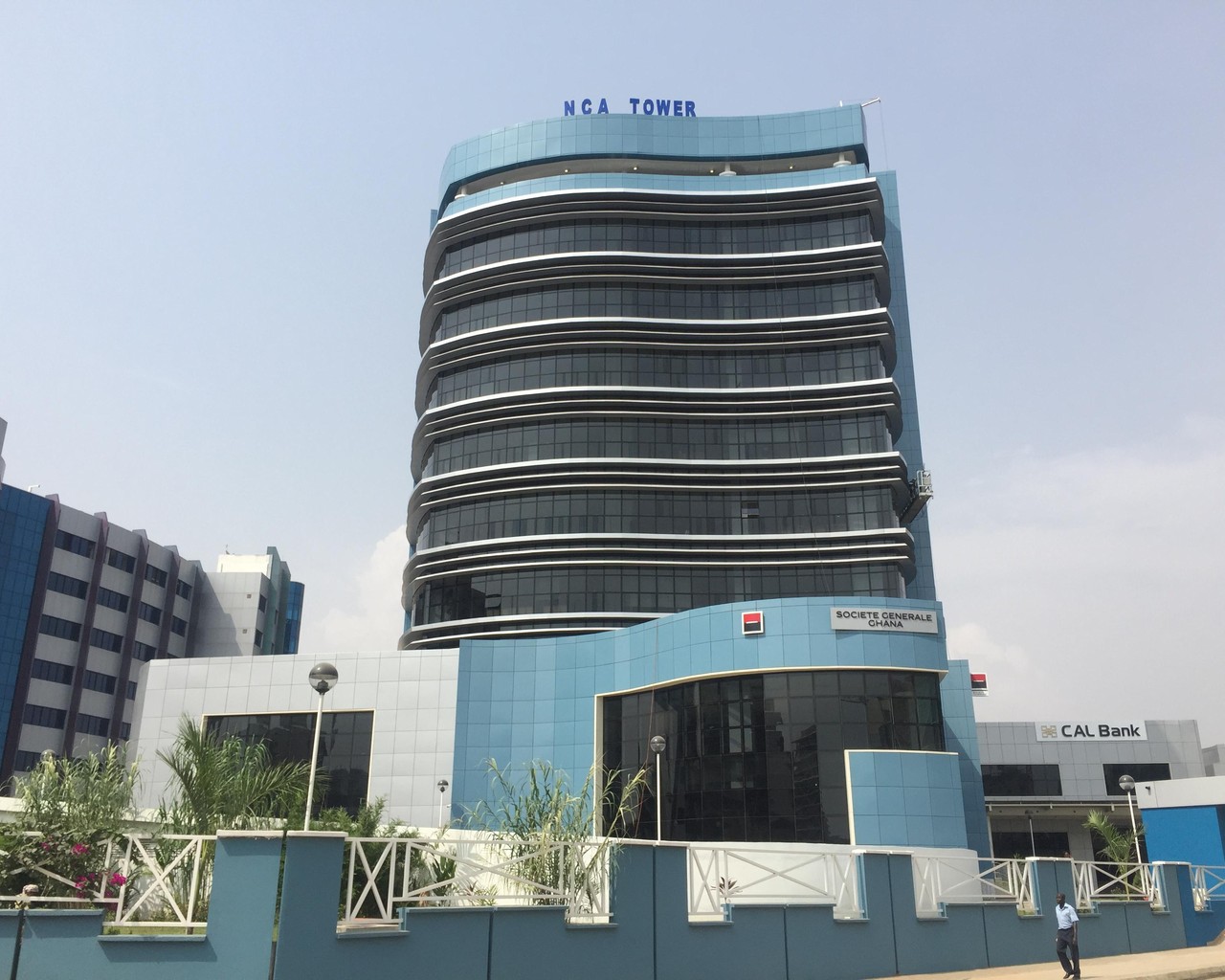
The National Communications Authority (NCA) is moving to strip Next-Gen Infraco (NGIC) of its 5G exclusivity in Ghana, signaling a major shift in the country’s telecommunications landscape.
Driving The News
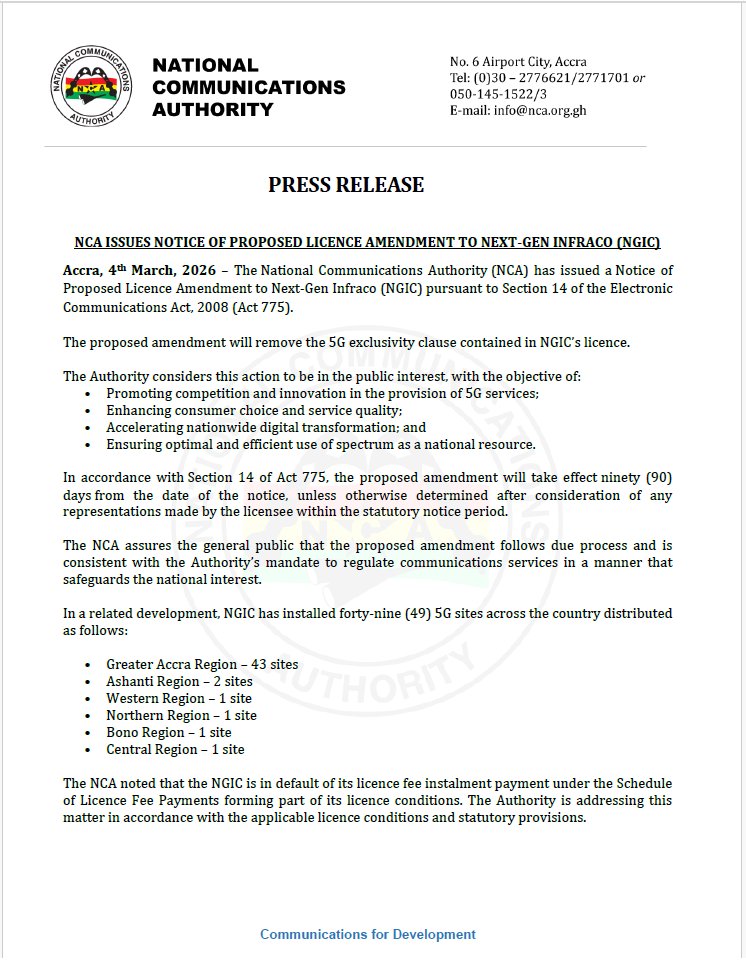
By invoking Section 14 of the Electronic Communications Act, 2008 (Act 775), the NCA is effectively pivoting toward an open-market strategy. The proposed amendment focuses on four key pillars:
- Competition: Driving innovation by allowing multiple players to offer 5G.
- Consumer Choice: Improving service quality through market pressure.
- Efficiency: Ensuring spectrum—a finite national resource—isn’t sitting underutilized.
- Speed: Accelerating the rollout of next-gen tech across the country.
Why it matters
The move aims to break a potential monopoly on high-speed connectivity, opening the door for other carriers to compete directly in the 5G space. The NCA argues this is essential for “public interest” and accelerating digital transformation.
By the numbers: NGIC’s current footprint
Despite its exclusivity to date, NGIC’s physical rollout remains heavily concentrated in the capital. As of March 4, 2026, the company has installed 49 sites:
| Region | 5G Sites |
| Greater Accra | 43 |
| Ashanti | 2 |
| Western | 1 |
| Northern | 1 |
| Bono | 1 |
| Central | 1 |
Between the lines
The regulatory hammer isn’t just about competition policy; there are signs of friction between the regulator and the provider.
- The Default: The NCA revealed that NGIC is currently in default of its license fee installment payments.
- The Countdown: NGIC has 90 days to make representations (legal arguments) against the amendment before it becomes permanent.
What’s next
If the amendment proceeds as expected, major mobile network operators (MNOs) in Ghana will likely scramble to secure their own 5G spectrum or partnerships.
For NGIC, the focus shifts from being the sole gatekeeper to proving its infrastructure is competitive enough to survive in a crowded market.