




Nigeria’s electricity problem is not new. It is not improving. And it is not small.
Nearly half the country’s population has no grid access at all, and those who do face outages so frequent that generators have become a standard line item in household and business budgets.
For millions of Nigerians, reliable power is not infrastructure — it is a daily expense to be negotiated, rationed, and often foregone.
Clean energy startup bPOWERd thinks it has a better deal.
A Box, a Battery, and a Mobil Station
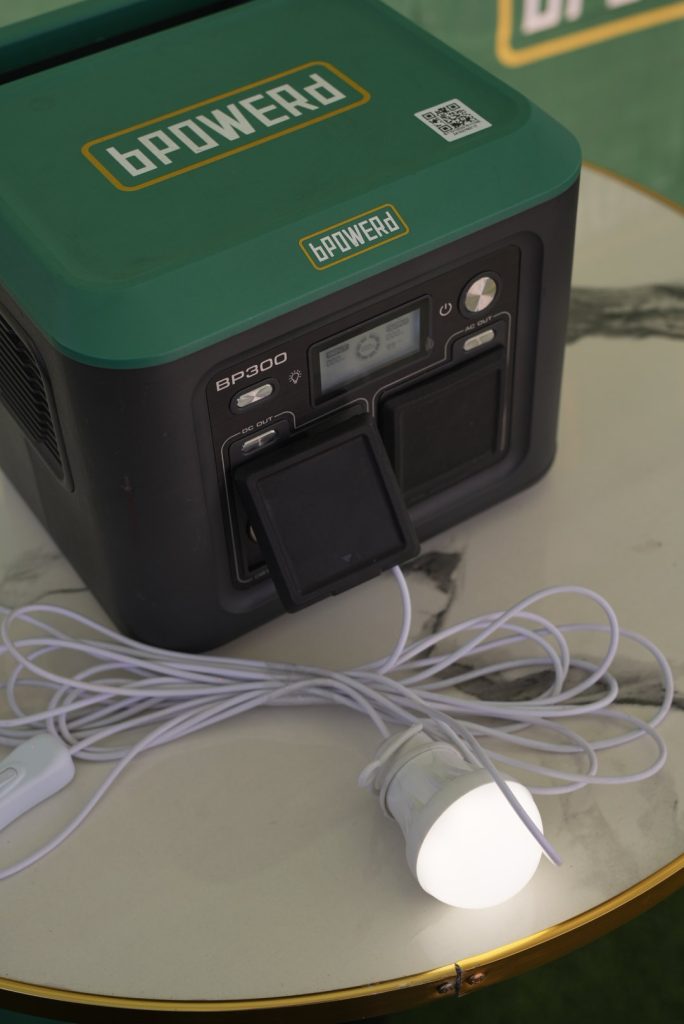
The South Africa-born company — developed under bp and launched in 2025 — has moved into Lagos with a deceptively simple model: portable, solar-charged batteries available for rent at Mobil service stations, operated in partnership with 11plc.
No installation. No contract. No generator fumes. Pay a refundable ₦15,000 deposit, pick up a battery, and return it when you’re done.
The company has established seven sites across Lagos since entering the Nigerian market, and the early numbers are striking. bPOWERd reached 60% of its six-month rental target within seven weeks of going live — suggesting the product is meeting a demand that was already there, fully formed, waiting.
The Math Makes the Case
Running a small generator — the kind that powers a few lights, a fan, maybe a television — costs the average Nigerian household roughly ₦10,000 per day in fuel. A bPOWERd battery delivering up to 12 hours of equivalent power runs ₦3,000. That is a 70% reduction in daily energy costs, with no exhaust, no noise ordinance violations, and no jerry cans to fill.
Two battery sizes are available. The smaller 300Wh unit starts at ₦1,500 per day and handles lights, phones, and small electronics. The larger 1,000Wh battery starts at ₦3,000 and can power refrigerators, fans, televisions, and basic small business equipment. Both are charged with solar power before rental.
The model targets urban households and small business owners — the segment that bears the heaviest cost of grid instability and typically has the fewest alternatives.
Green Infrastructure, Local Jobs
bPOWERd is positioning its Lagos expansion as more than a product rollout. The company is creating on-site sales roles at its Mobil station locations and building partnerships with Nigerian solar technicians as part of what it describes as local green workforce development.
Oluwole Ogidan, Head of bp Global West Africa, framed the ambition plainly: “Our focus is on delivering diversified energy solutions that are affordable, resilient, and adaptable to how people live and work. Beyond expanding access to reliable power, this rollout also supports the growth of a local green workforce through on-site sales roles and partnerships with Nigerian solar technicians.”
That workforce angle matters in a market where the informal energy economy — generator repair, fuel resale, power bank charging stations — already employs a significant number of people. bPOWERd is, in effect, proposing a cleaner version of an ecosystem that already exists.
From Joburg to Lagos
The South Africa launch in 2025 produced 125,000 rentals in the first 12 months — a volume that gave bPOWERd enough proof of concept to make the Nigerian leap.
The two markets are meaningfully different: South Africa’s grid is unreliable and politically contentious, but it exists in a way Nigeria’s does not for tens of millions of residents. Nigeria demands a product that works for people who may never have had stable electricity at all, not just those tired of scheduled outages.
Managing Director Jonathan Lule acknowledged the stakes: “Small businesses sit at the center of everyday economic activity, yet many continue to operate against the backdrop of unstable and expensive power. bPOWERd is helping households and small and medium-sized enterprises access dependable pay-per-use power they can rely on.”
The Bigger Bet
What bPOWERd is ultimately testing in Lagos is whether pay-per-use clean energy can compete with fossil fuel incumbency on pure economics — not on ideology, not on climate messaging, but on daily cost and convenience.
The generator industry in Nigeria is enormous, deeply entrenched, and supported by an entire supply chain of fuel distribution and maintenance.
Seven sites and seven weeks of strong early uptake do not disrupt that ecosystem. But they do suggest a wedge.
If the unit economics hold as bPOWERd scales — more sites, more batteries in circulation, solar charging infrastructure spreading across the Mobil network — the model could become a template for distributed clean energy access across West Africa’s most populous and power-starved market.