






Three days before a wedding, Diana Evans‘ seamstress announced she had lost her measurements. The dress had to be remade from scratch. It was the kind of moment that would frustrate anyone, but for Evans, it was a revelation.
Here was one of the most detail-dependent industries in the world, running entirely on handwritten notebooks, stained paper, and memory.
That crisis became the founding idea behind boafuo — a WhatsApp-based business platform built specifically for tailors in Ghana.
Developed by Haxo Labs, a research-driven engineering company co-founded by Evans and technical lead Ronny Panford, boafuo aims to professionalize one of Africa’s most skilled but administratively fragile workforces.
Both founders are graduates of Ashesi University, where they did their undergraduate studies. Panford has seven years of experience in software engineering and holds a Mechanical Engineering master’s degree from Imperial College London.
Evans is the Business Lead with five years of marketing experience and holds a master’s degree in Marketing from Brunel University London.
Together, they are attempting to solve a problem that will help automate communication and “coaches” tailors to stay ahead of deadlines.
The Notebook Problem
The informal tailoring sector in Ghana is enormous, highly skilled, and almost entirely analog in its back-office operations. Evans and Panford spent months conducting ethnographic research — observing how tailors in Accra, Kumasi, and Tamale managed their day-to-day before building a single line of code.
What they found was a systemic information crisis. Tailors were storing client measurements, fitting dates, and fabric details in physical notebooks that could be torn, soaked, or simply lost. Client communication happened through fragmented WhatsApp threads. There was no dedicated system for any of it.
The consequences went beyond inconvenience. Misplaced measurements meant remade garments. Missed fitting reminders damaged reputations. The common stereotype of the “unreliable tailor” was, in many cases, not a character flaw but an infrastructure failure.
“This lateness is frequently a direct result of environmental and administrative burdens,” Evans says. “Frequent power outages can bring a workshop to a complete standstill. They are also constantly interrupted by client inquiries on WhatsApp, forcing them to stop their craft to act as receptionists.”
A Platform That Thinks Like a Tailor
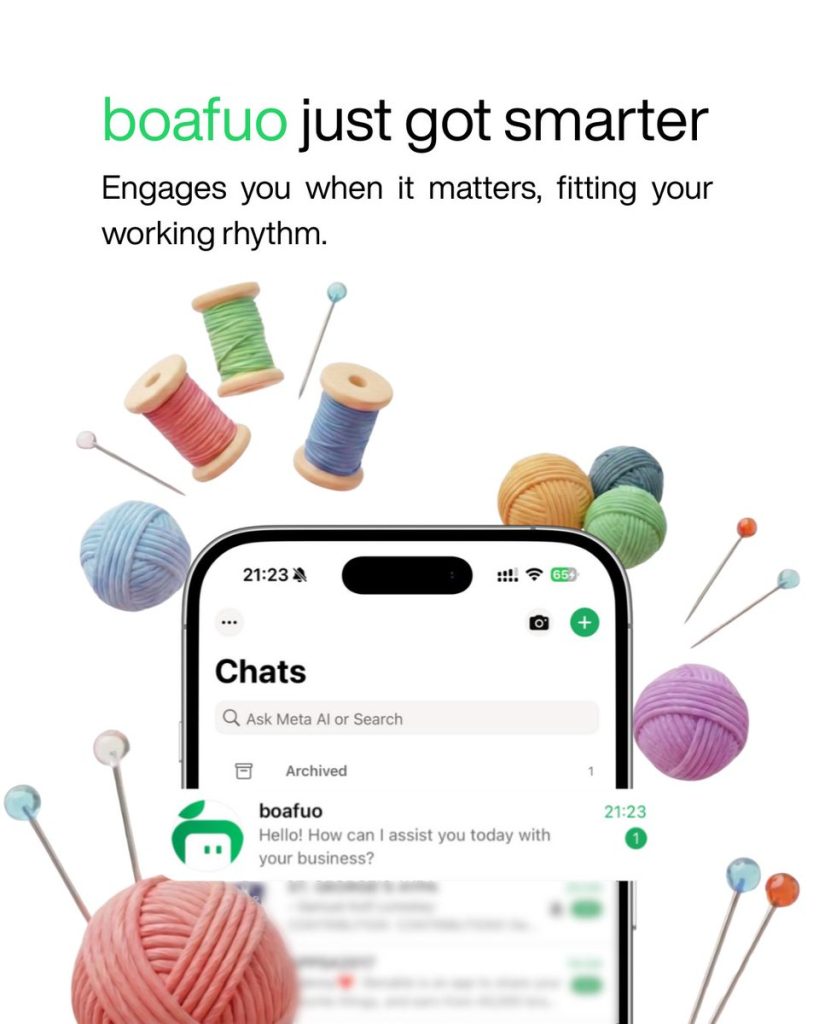
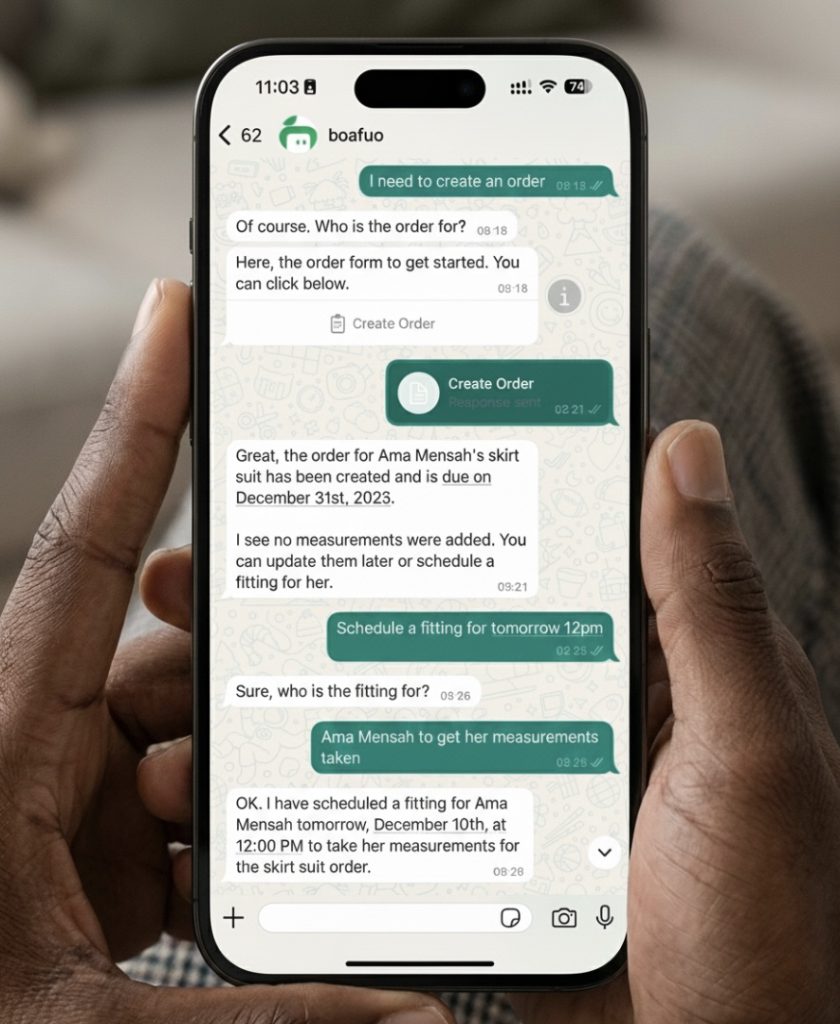
boafuo’s core design decision was not to build an app. Instead, it lives entirely inside WhatsApp — the communication platform most Ghanaian tailors already use daily to talk to family and customers. There is nothing new to download, no new interface to learn.
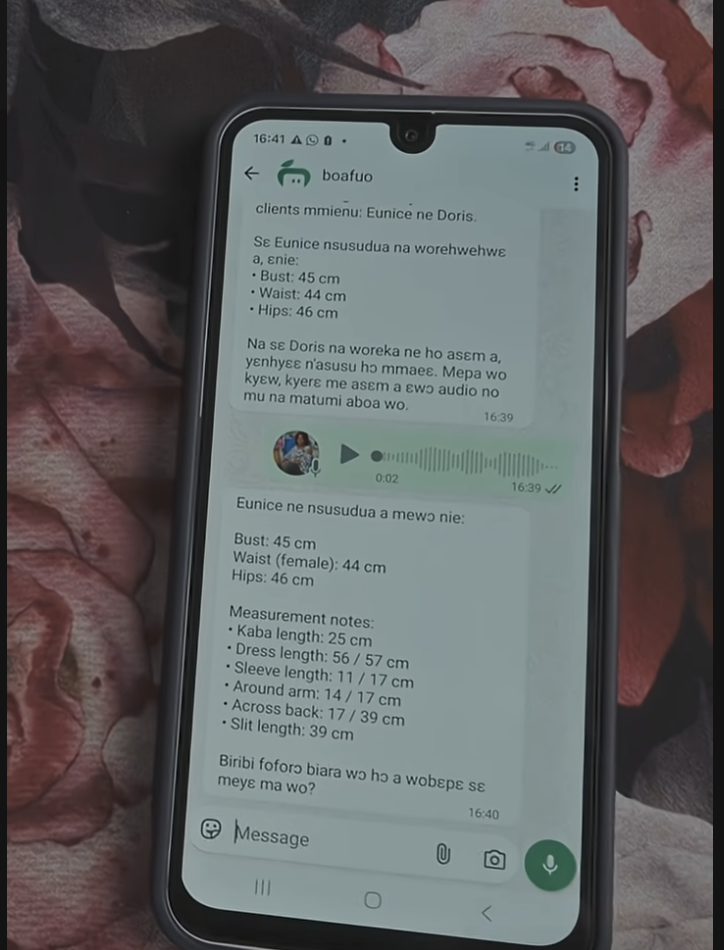
When a tailor inputs an order — whether by text or voice note, in English or Twi — boafuo’s natural language processing extracts the relevant data: measurements, garment type, delivery dates, and fabric notes. That information is stored in what the company calls a “Measurement Vault,” a digital record that replaces the physical notebook.
The system then does what no notebook can: it tracks the active lifecycle of every garment through production stages — cutting, sewing, fitting — and automatically sends clients fitting reminders and pickup alerts via WhatsApp. Essentially, the tailor stops acting as a receptionist.
But the more ambitious layer of boafuo is what the team calls “production intelligence.”
Three custom AI models analyze each tailor’s behavioral patterns and workload over time, offering proactive suggestions rather than waiting to be asked. It is designed to shape working habits, not just record information.
“boafuo is not a passive ‘ask and answer’ tool,” Evans says. “It plans and coordinates — offering assistance before it is even requested.”
Earning the Trust of Artisans
Selling software to traditional artisans is not straightforward. The very act of asking a tailor to move away from their notebook means asking them to trust an invisible system with information their entire business depends on.
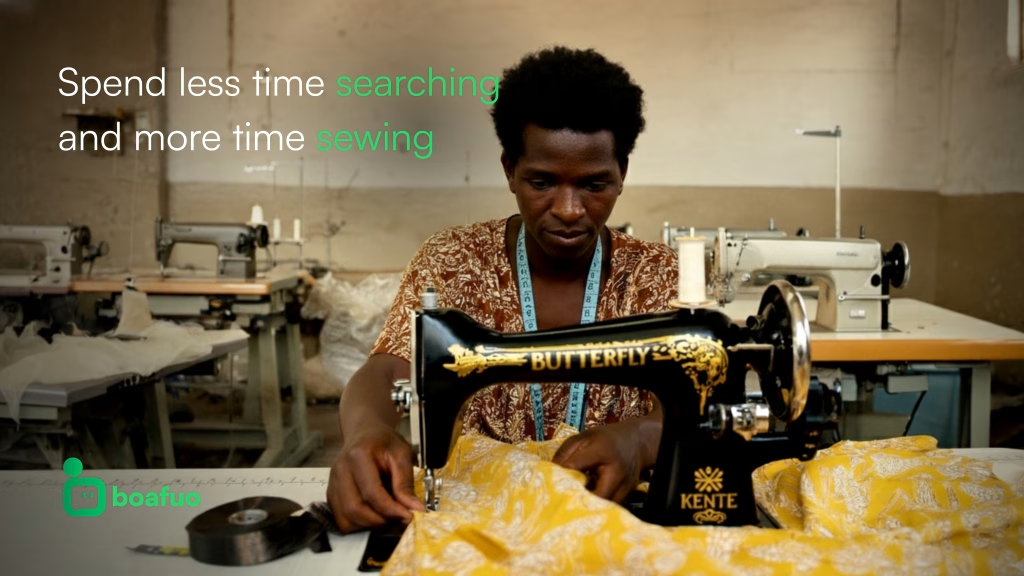
Panford and Evans broke this challenge into three problems: the trust gap, technical intimidation, and the need for community validation. The first required demonstrating that a digital vault is harder to lose than paper.
The second meant reframing boafuo not as AI — a word that implies complexity and, in some contexts, replacement — but as a professional assistant. The third was the hardest: artisan communities move on peer trust, not product demos.
“Overcoming this required reaching a social proof threshold,” Evans explains, “where respected peers successfully managed hundreds of orders on the platform. Seeing a colleague maintain perfect records while saving time was the catalyst.”
One of their most cited early users is a tailor named Aunty Comfort, who spent years managing client measurements and details through a combination of notebooks and memory.
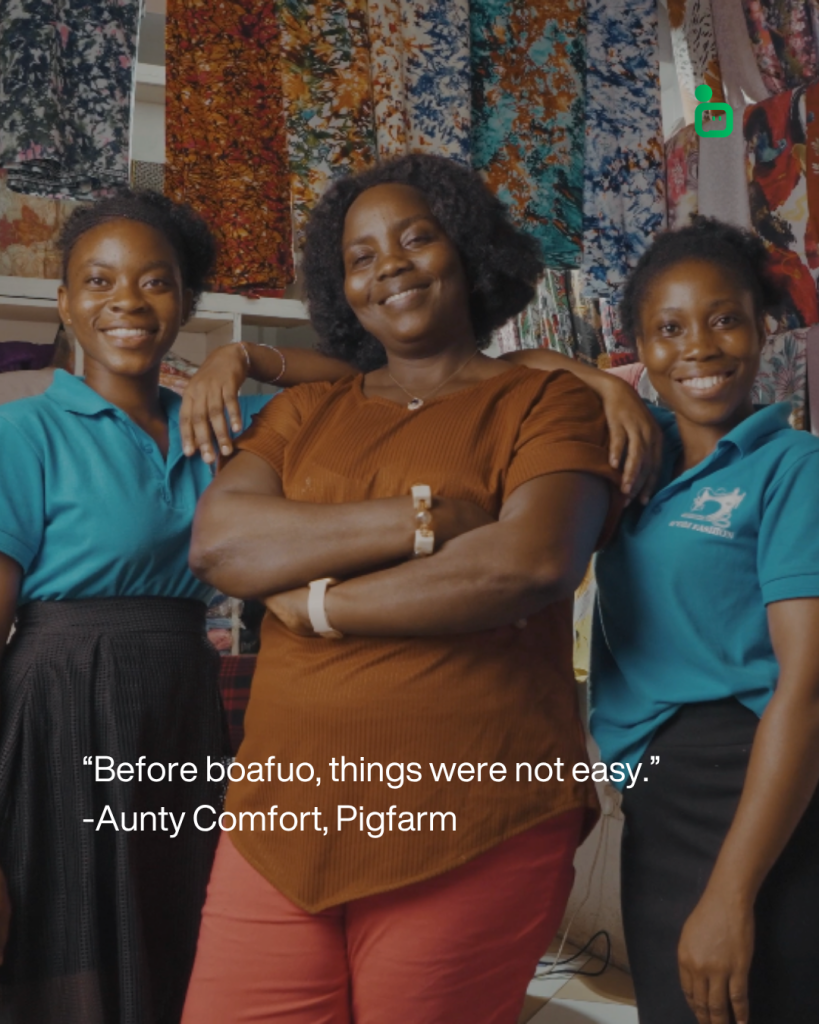
After adopting boafuo, her scheduling moved to the platform, her clients began trusting that fittings would happen on time, and the administrative chaos that had dominated her workdays started to ease.
With boafuo, Aunty Comfort just has to send voice notes to boafuo with clients’ details instead of resorting to a physical notebook.
The most unexpected feedback, though, has come around stress.
Tailors don’t just report that boafuo saves time. They report that it makes them feel less overwhelmed — that having a system that manages client communication and tracks orders frees them to focus on what they are actually good at.
From Seamstresses to Carpenters
boafuo currently operates on a free model. The measurement vault, order tracking, and a forthcoming payment integration are all available at no cost.
A future premium tier will introduce a desktop analytics dashboard and brand customization, allowing larger shops to send client communications under their own name rather than boafuo’s.
The longer ambition, though, extends well beyond tailoring. The underlying architecture — a spec vault, production tracking, and client transparency layer — applies to any skilled trade managing complex bespoke orders.
Panford and Evans are explicit that carpenters, welders, and mechanics face structurally identical problems.
“Whether you are measuring a sleeve for a suit or the dimensions for a cabinet,” Evans says, “the underlying need is the same.”
For now, the focus is on the tailor sitting at a sewing machine in Kumasi with a notebook full of measurements and a WhatsApp inbox full of clients asking if their dress is ready.
boafuo’s bet is that the same phone already in their pocket is all they need to run a modern business. The notebook, it turns out, was always the bottleneck.