






For more than a decade, getting a national ID card in The Gambia has meant navigating a system that citizens describe as unreliable at best.
Contracts have expired, been renegotiated, and collapsed outright, leaving stretches where new cards simply weren’t being issued at all.
That history is the backdrop for last week’s launch of the National Identity Management System, or NIMS, a project the government is presenting not just as a card upgrade but as a foundational piece of digital infrastructure. President Adama Barrow enrolled as the first citizen at a June 30 ceremony, receiving what officials are calling the GAM ID.
The system was built by Margins ID Systems Applications, a subsidiary of Ghana’s Margins ID Group, under a Build-Operate-Transfer arrangement — the same model the company has used across its identity projects on the continent.
The Gambia deal followed roughly five years of negotiation before MIDSA was formally awarded the contract this past January.
A System Built on the Ruins of the Last One
The Gambia’s identity infrastructure has gone through several incarnations since 2009, when Innovatrics first deployed biometric deduplication with a local partner.
A subsequent six-year contract with Belgian firm Semlex, signed in 2016, was terminated and then restored after renegotiation — only for card issuance to stall again once that agreement ran its course. Gambian lawmakers spent much of last year pressing the Interior Ministry on why citizens couldn’t get ID cards at all.
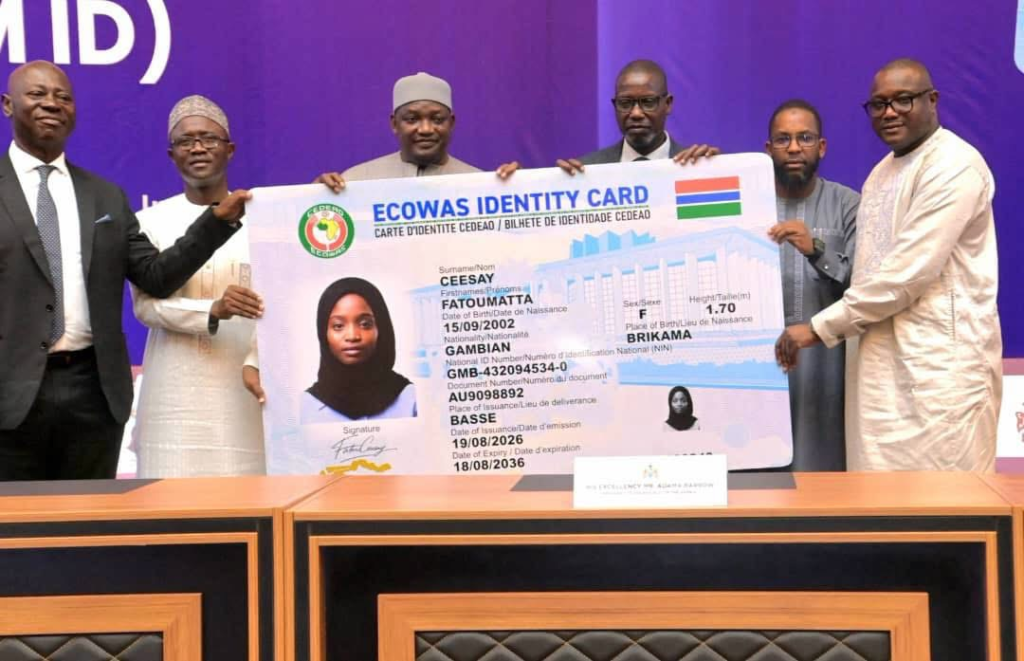
That churn is why officials are emphasizing durability as much as technology.
Prof. Abdou Karim Diallo, Director General of the Gambia Information and Communication Technology Agency, framed the new card as a trust-building exercise as much as a technical one — an attempt to give citizens and the private sector a single, dependable credential after years of an identity system that was, in the government’s own characterization, fragmented and contractually troubled.
What “Sovereign” Actually Means Here
The word doing the most work in Margins’ pitch is “sovereign.” Company CEO Moses Baiden Jr. pointed to a newly constructed data center intended to host the NIMS database inside The Gambia, rather than routing citizen biometric data through infrastructure controlled by a foreign vendor — a pointed contrast with the Semlex-era arrangement.
It is also part of a broader argument Baiden has made at industry gatherings like the ID4Africa summit for identity systems that African governments actually own and control.
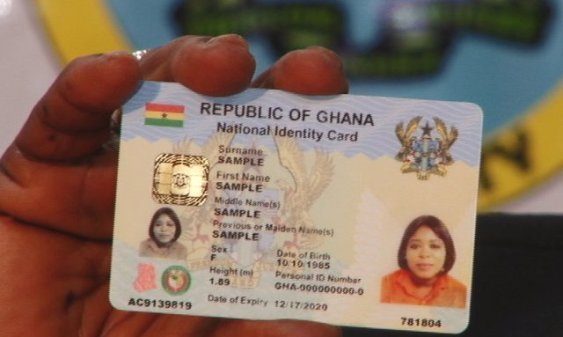
It’s a pitch built on Margins’ own track record. The company has spent more than three decades building out Ghana’s identity infrastructure, most visibly the Ghana Card, which now underpins verification across the country’s banking and telecom sectors and has processed over 200 million biometric checks.
Margins has used that experience — and a certification portfolio spanning cybersecurity and secure card production — to position itself as one of the few African-owned firms capable of running one of these systems end to end, rather than serving as a subcontractor to European vendors.
Real-Time Issuance, If It Holds
The other headline feature is speed. The government says GAM ID cards will be issued the moment someone completes biometric enrollment, replacing what had been a delayed, bureaucratic process — a design choice the government links to the World Bank’s push for inclusive, user-centric digital ID systems.
A pilot phase runs from July 6 to 29 at select institutions, with nationwide enrollment beginning August 4. Margins has also donated vehicles to support enrollment logistics, according to a company statement.

Instant issuance is a meaningful improvement on paper, but The Gambia’s history offers reason for measured optimism rather than certainty: the country’s previous systems also launched with strong governmental backing before running into contractual friction years down the line.
Whether NIMS avoids that fate will depend less on the launch ceremony than on how the BOT agreement holds up once the initial enthusiasm fades — and on operational details the government hasn’t yet detailed publicly, including enrollment targets, the system’s cost to Gambian taxpayers, and what happens to data collected under the earlier Semlex-era system.
Part of a Wider Pattern
The Gambia isn’t acting in isolation. Other African governments — including the Democratic Republic of Congo — have been examining Ghana’s identity model as a template, and Margins has increasingly positioned itself as an alternative to the European and Middle Eastern vendors that have historically dominated African ID contracts.
For a company built from a modest domestic printing operation into a continental identity player, The Gambia contract is as much a proof point for that expansion strategy as it is a fix for Banjul’s card problem.
Whether it succeeds will be measured less by the optics of a presidential enrollment ceremony than by whether ordinary Gambians can reliably get a card a year from now — something the country hasn’t consistently managed in over a decade of trying.