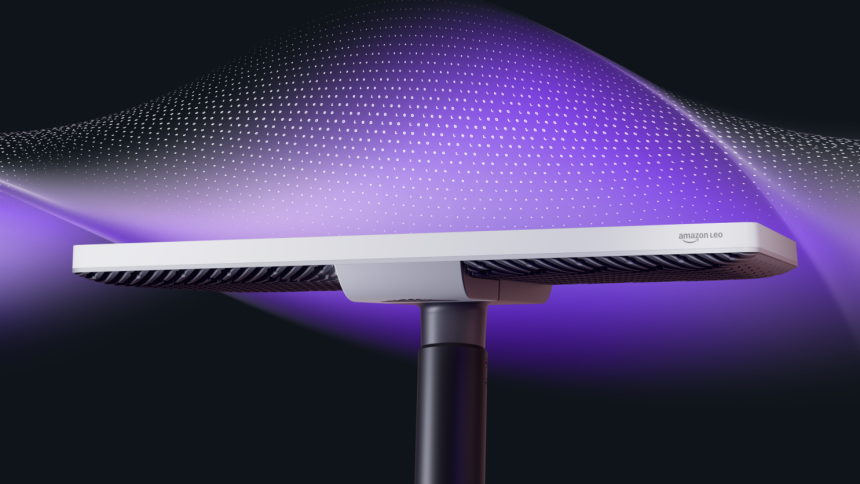
Amazon’s Project Kuiper—rebranded as Amazon Leo—has secured a landing permit from Nigeria’s Communications Commission (NCC), setting up a direct confrontation with Elon Musk’s Starlink in Africa’s most populous nation.
Why it matters
Nigeria is the ultimate testing ground for satellite internet. With over 23 million people currently living in unserved or underserved areas, the winner of this “space race” gains a foothold in a market where 50% of the population still lacks mobile broadband.
The State of Play
The NCC permit, effective February 28, 2026, grants Amazon a seven-year window to deploy its low Earth orbit (LEO) constellation.
- The Scope: Unlike basic providers, Amazon is licensed for Fixed Satellite Service (homes/offices), Mobile Satellite Service (maritime/aviation), and Earth Stations in Motion (vehicles).
- The Spectrum: Operations will run on the Ka-band ($17.7–30.0$ GHz), providing high-capacity throughput capable of competing with fiber optics.
The “Amazon Advantage”
While Starlink has a head start, Amazon is playing a different game by leveraging its existing ecosystem:
- AWS Integration: Enterprise clients already on Amazon Web Services can link cloud workloads directly to satellite backhaul—a massive “stickiness” factor for corporate Nigeria.
- Logistics Mastery: Amazon’s ability to move hardware through complex supply chains could solve the “last-mile” delivery and support issues that have plagued Starlink users in rural provinces.
- Manufacturing Scale: A Kirkland-based facility producing five satellites per day allows Amazon to scale its constellation faster than almost any competitor in history.
Hardware: The Three-Tier Strategy
Amazon is segmenting the market by price and performance to capture every demographic:
| Terminal | Target Market | Speed | Form Factor |
| Leo Nano | Individuals/Students | Up to 100 Mbps | <18cm square; ~1kg |
| Leo Pro | Small Businesses | Up to 400 Mbps | 28cm; 2.4kg |
| Leo Ultra | Enterprise/Gov | Up to 1 Gbps | Flagship flagship antenna |
The Competitive Landscape
Amazon enters a market where Starlink is already the #2 ISP by subscriber count, despite high costs.
- Starlink’s Vulnerability: As of mid-2025, Starlink had 66,523 subscribers, but capacity constraints in Lagos and Abuja have led to waitlists.
- Pricing Volatility: Starlink prices in Nigeria jumped from NGN 38,000 to NGN 57,000 in May 2025 due to currency instability.
- The Opening: If Amazon can offer stable pricing or better urban capacity, it could rapidly peel away Starlink’s frustrated power users.
What’s Next
- Waitlist Open: Amazon is already taking sign-ups for government, corporate, and personal users.
- Rollout: Enterprise testing began in late 2025; expect full commercial availability by Q2 2026.
- The Regulatory Clock: Amazon must deploy half of its planned 3,236 satellites by July 2026 to satisfy its global licenses.
Source: Space in Africa