




Egypt has one of the fastest-growing consumer finance markets in the Middle East, but fewer than 5 percent of Egyptian adults have access to formal credit. A Cairo-based fintech called Blnk is betting it can close that gap — one checkout counter at a time.
The company announced Monday that it has raised $37 million: $12.5 million in Series A equity and $24.6 million in local debt facilities.
The equity round was led by Algebra Ventures, with participation from SANAD Fund for MSME, Endeavor Catalyst and Emirates International Investment Company, the Abu Dhabi-based firm that also backed Blnk’s seed round. Debt funding came from several Egyptian banks, including the National Bank of Egypt, Suez Canal Bank, and Bank Albaraka.
How It Works
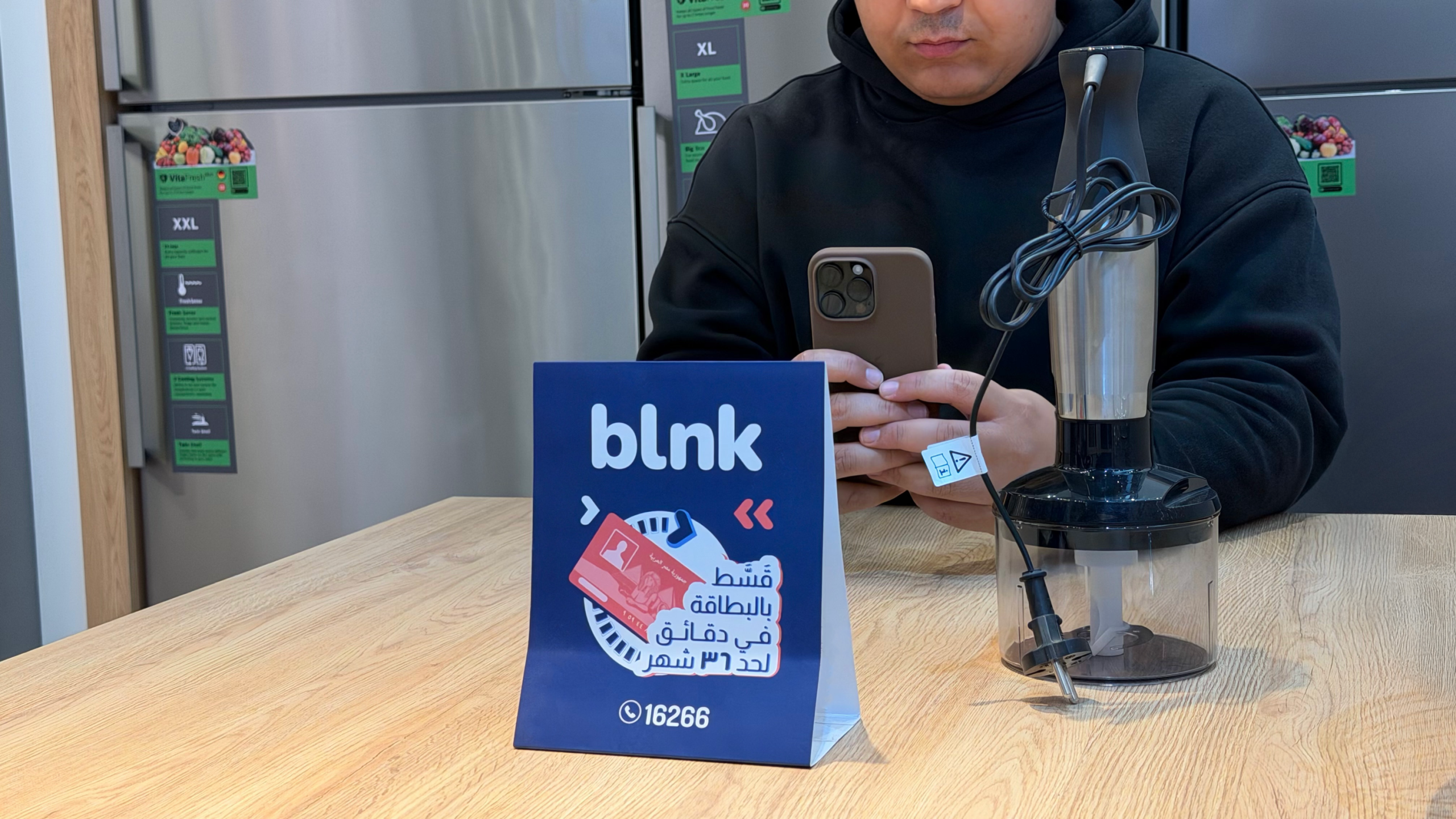
Blnk’s model is straightforward: a customer walks into a store, applies for financing at the point of sale, and receives a credit decision in about three minutes.
No lengthy paperwork. No branch visits.
Loan terms range from six to 36 months and are available at more than 3,000 merchant locations across Egypt, covering electronics, furniture, household appliances and automotive services.
The speed is possible because Blnk uses proprietary algorithms to assess creditworthiness in real time. Rather than relying on traditional credit scores — which exclude most Egyptians who lack formal banking histories — the system analyzes what the company describes as hyper-local variables to build dynamic risk profiles.
Machine learning models then generate instant probability-of-default predictions, allowing the company to price loans based on individual risk.
Who Is Actually Getting Loans
The numbers Blnk has shared suggest it is reaching people that traditional lenders have long ignored. Of the more than one million customers the company has onboarded since its seed round in late 2022, 75 percent were previously unbanked or underserved. Over 35 percent are women.
That last figure matters in a country where only 3.9 percent of women use credit cards or digital lending tools, according to Egypt’s Financial Regulatory Authority. Improving bank account ownership has not automatically translated into access to usable credit — particularly for women — and Blnk’s numbers indicate it is making some headway on that specific problem.
Egypt’s consumer finance sector reached roughly 96.3 billion Egyptian pounds, or about $2 billion, in 2025, a 57 percent increase from the previous year. That growth reflects rising demand, but structural barriers — sparse credit histories, distrust of banks, geographic concentration of financial services — have kept millions of Egyptians out of the formal lending system.
A Business That Has Turned Profitable
The company reached profitability in 2025 and reported a 173 percent year-on-year revenue increase. Its loan portfolio has surpassed one billion Egyptian pounds.
Karim Hussein, managing partner at Algebra Ventures, said in a statement that Blnk’s ability to serve underbanked consumers while maintaining “disciplined credit management” made it a “category-defining player” in Egypt’s consumer finance market.
The debt component of the raise — $24.6 million from banks and non-bank financial institutions — is particularly significant. It signals that traditional lenders are willing to fund a company whose core thesis is that the people banks typically reject are actually creditworthy when assessed correctly.
What the Money Will Fund
Blnk plans to use the new capital to expand its merchant network, develop new product categories and, eventually, launch a credit card that would allow customers to use their credit limit outside of Blnk’s existing merchant network. The company also indicated it would explore geographic expansion beyond Egypt, though no specific markets were named.
The credit card ambition is the most telling part of that roadmap. Point-of-sale financing is a well-established model, but a credit card would transform Blnk from a checkout tool into a broader financial product — and deepen its relationship with customers who currently only interact with it when making a specific purchase.
Amr Sultan, Blnk’s chief executive and co-founder, said the funding would allow the company to expand its reach and diversify its offerings while continuing to focus on underserved consumers.