





Ghana’s telecom regulator has formally launched the country’s first competitive auction for 5G spectrum, inviting mobile operators and new entrants to bid for airwaves that will determine who controls next-generation wireless capacity in the country for the next 15 years.
According to early reporting by TechFocus24, the National Communications Authority (NCA) has released a 32-page Request for Applications on July 16 covering three frequency bands — 700 MHz, 2.3 GHz, and the 3 GHz mid-band — with a submission deadline of August 6.
The move formalizes what the regulator describes as a shift to competitive 5G licensing, effective July 15, ending an earlier arrangement in which 5G deployment had been managed outside an open bidding process.
What’s on the table
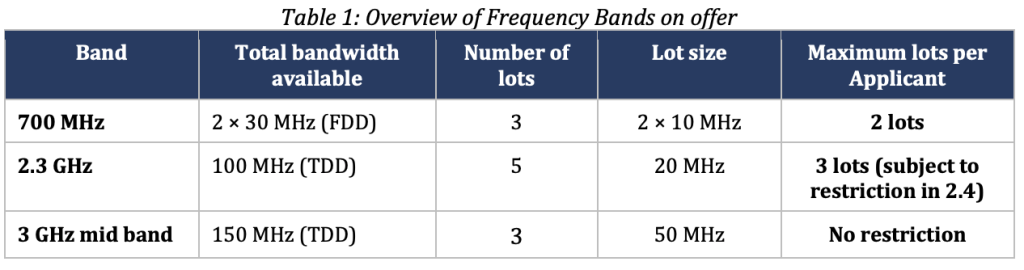
The auction covers 11 total lots. The 700 MHz band, prized for its long-range coverage in rural areas, offers three lots of 2×10 MHz each. The 2.3 GHz band has five 20 MHz lots. The 3 GHz mid-band — the workhorse spectrum for urban data capacity — offers three lots of 50 MHz each.
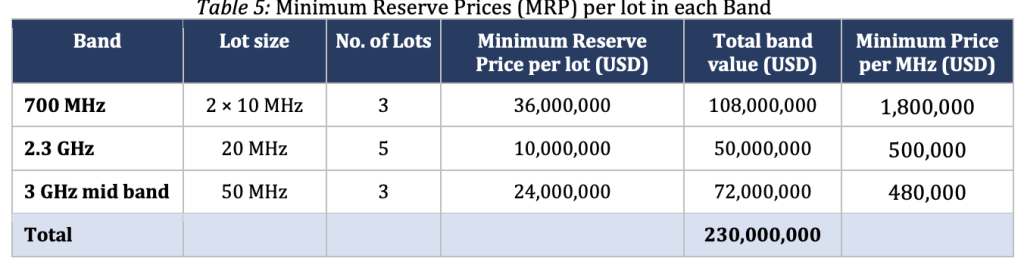
Combined, the minimum reserve prices across all bands total $230 million, with 700 MHz commanding the highest per-megahertz value at $1.8 million, reflecting its scarcity and propagation advantages.
Notably, the document does not name incumbent operators beyond MTN, nor does it disclose how much spectrum any current player already holds outside the bands on offer — a gap that will matter once bidding starts, since existing spectrum holdings shape both competitive strategy and regulatory scrutiny.
A built-in penalty for the dominant player
The clearest signal of the NCA’s competitive intent is a 40 percent price premium applied specifically to MTN Ghana, the only operator currently designated as holding “significant market power.”
The premium applies only in the 700 MHz and 3 GHz mid-bands, pushing MTN’s effective per-lot cost to $50.4 million and $33.6 million respectively — well above the $36 million and $24 million base prices other bidders would pay.
The mechanism is explicitly framed as a competition safeguard rather than a revenue measure, and it’s paired with a wholesale roaming obligation: if MTN wins spectrum, it must offer national roaming to rival operators on non-discriminatory, cost-based terms, with a reference offer due within 90 days of licensing.
The document doesn’t specify what happens if a merger or acquisition changes SMP designation mid-license, an omission that could matter over a 15-year term in a market where consolidation talk (including around struggling AT Ghana) has been persistent.
Coverage obligations with real teeth
Winners face an aggressive rollout timeline. All licensees must cover 70 percent of Ghana’s population — measured against the 2021 census — by March 6, 2027, less than eight months after the bidding process concludes. That includes mandatory coverage of Greater Accra, Greater Kumasi, and all 16 regional capitals.
Rural coverage requirements are steeper for any operator designated SMP: 80 percent of the rural population by year five, alongside region-by-region thresholds. Download speed obligations also escalate — from a 7 Mbps floor at launch to 50 Mbps by year seven, with a 100 Mbps “aspirational” target aligned to international 5G standards.
Non-compliance carries real consequences: the NCA can impose fines, shorten license terms, suspend, or revoke licenses outright for persistent breaches.
Who can bid
Existing MNOs, MVNOs, broadband wireless providers, and ISPs can apply in their current corporate form. New entrants, however, must be 100 percent Ghanaian-owned — a requirement that could limit the field of new entrants but keeps the door open to fresh domestic competition.
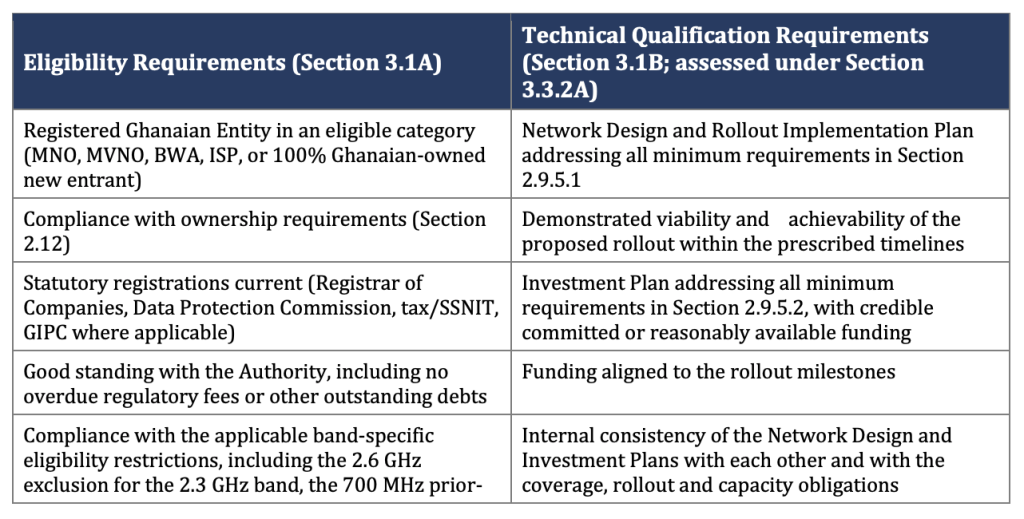
Applicants in the 2.3 GHz band face an additional restriction: any entity already holding 2.6 GHz spectrum is barred from bidding, a rule apparently designed to prevent existing capacity holders from further consolidating mid-band spectrum.
The process itself
The auction follows a two-envelope, sealed-bid format. Technical and financial qualifications are assessed first, on a pass/fail basis, before price offers are even opened — meaning an operator can’t buy its way past a weak rollout plan.
If lots are oversubscribed, a second sealed round follows; if undersubscribed, the NCA will offer remaining lots at the reserve price before treating any leftover spectrum as unsold.
The regulator has given itself broad latitude to amend or cancel the process “in the public interest,” with no compensation owed to applicants — a standard but consequential clause given the scale of capital at stake.
What’s missing from the document
The RFA is procedurally detailed but says little about how this auction interacts with Ghana’s broader spectrum strategy — including previous licensing history in the bands now on offer, or how much unassigned spectrum capacity currently exists in the market.
It also doesn’t address how AT Ghana, widely reported to be in financial distress, factors into eligibility or bidding capacity, a question likely to shape how competitive the field ultimately looks by August 6.