





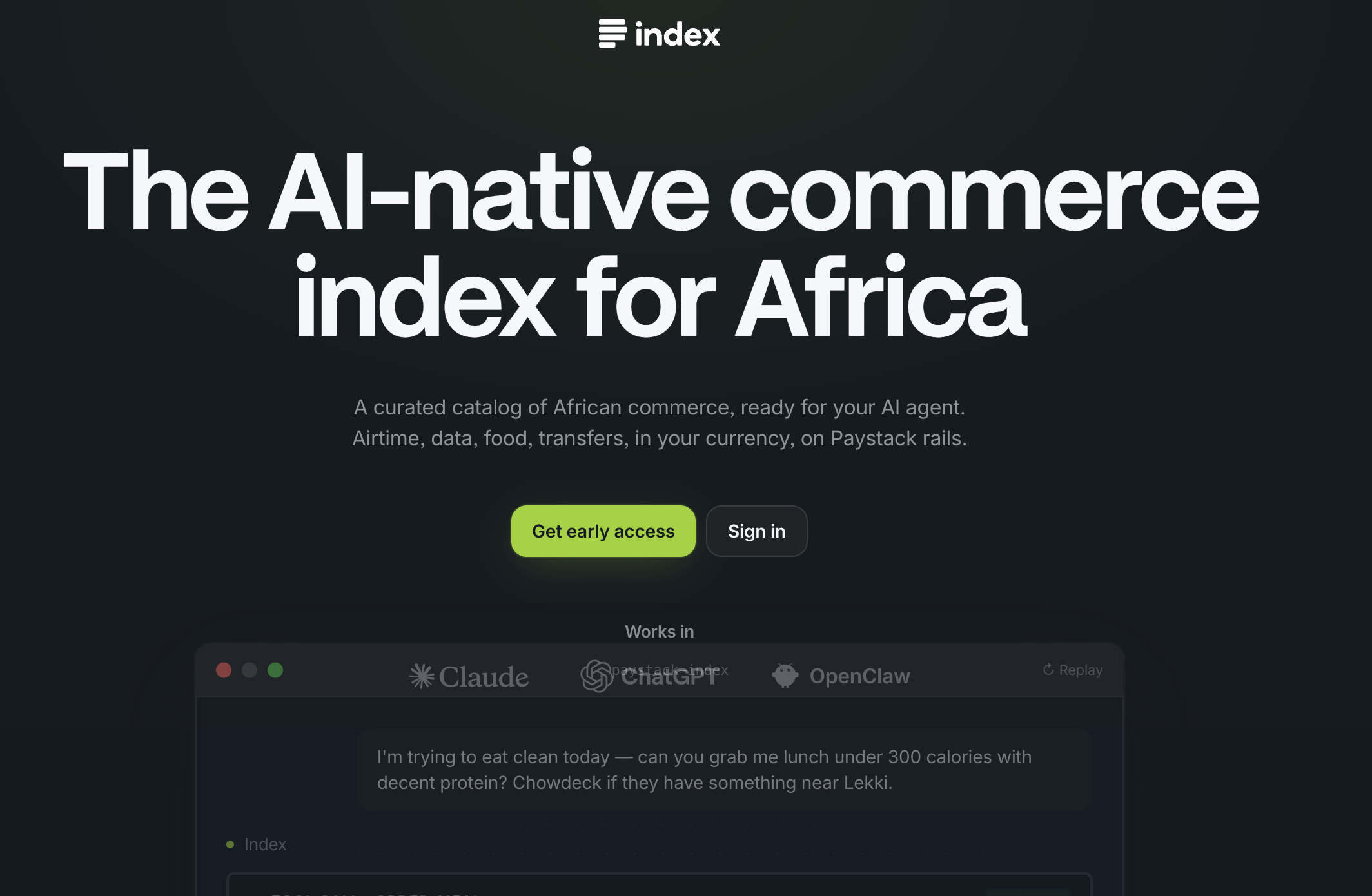
Paystack has launched Paystack Index, an early-access product that allows users in Nigeria to complete purchases through AI agents rather than traditional checkout flows.
Built on top of the company’s existing infrastructure — including Paystack Checkout and Zap, its consumer payments product — Index lets users instruct an AI assistant to handle routine transactions and have them completed without leaving the conversation.
The launch coincides with rising AI adoption in Nigeria.
According to a Google-Ipsos survey, 88 percent of Nigerians surveyed said they had used generative AI over the previous year, while 62 percent said they had used it for everyday tasks such as planning trips, meals, or workout routines. Paystack is betting that payments could be next.
How It Works
Rather than navigating websites and apps manually, users can ask supported AI agents to complete transactions on their behalf. Paystack Index interprets the request, routes it to the appropriate merchant or service provider, processes the transaction through Paystack and Zap’s infrastructure, and helps complete checkout within the AI experience.
At launch, the product works with Claude, ChatGPT, and OpenClaw. Supported use cases include airtime and mobile data purchases across major Nigerian networks, money transfers via Zap, and food orders through Chowdeck.
Currently, Paystack is not positioning the product around complex purchasing decisions. The initial use cases are largely routine and repeatable transactions that users already perform frequently. That scope is intentional: the company wants to understand how people behave when an AI agent becomes a purchasing interface before expanding to more complex commerce.
Who Controls the Transaction
One question any AI-powered payments product must answer is: who is actually in charge? Paystack says users are. The company said users would retain authority over what actions AI systems can perform through permissions and spending limits set by customers.
Transactions are processed through Paystack’s existing payments infrastructure, while the company said it does not store card numbers, CVVs, PINs, or bank account credentials.
Users configure those controls after signing up, setting guardrails around what an AI agent is authorized to do on their behalf. Index only acts on requests sent through a user’s chosen AI client — it does not operate autonomously.
A Long Bet on Agentic Commerce
The launch is the first public product to emerge from TSG Labs since Paystack announced the creation of The Stack Group in January 2026 — a holding company that brings together Paystack, Zap, Paystack Microfinance Bank, and TSG Labs, a venture studio focused on building experimental products that may be too early or uncertain for the group’s more established businesses.
“As AI agents become a more common way for people to search, decide, and take action, we think checkout has to evolve too,” said Shola Akinlade, Paystack’s chief executive. The company frames Index less as a revenue play and more as a research exercise.
Akinlade does not expect immediate mass adoption. “The thing we know is that there’s a bunch of early adopters in Nigeria or in Africa — there are people that used ChatGPT on the first day,” he said. The company expects that process to take time and does not anticipate significant traction for at least another year.
Paystack is framing Index as an infrastructure experiment — a way to study AI-led commerce before the market matures, rather than race to capture it.
What Comes Next
The rollout is initially limited to Nigeria as part of a controlled beta program that Paystack said will help it understand how consumers interact with AI-led commerce experiences and what infrastructure merchants may require as usage evolves.
Paystack plans to gradually expand Index with additional features, supported merchants, billers, and African markets as it continues learning from user behavior during the beta. The company currently curates which merchants can participate, though Akinlade suggested that approach could loosen as the product matures.
Paystack currently serves more than 300,000 organizations across Nigeria, Ghana, South Africa, Kenya, and Côte d’Ivoire. Whether Index eventually scales across those markets will depend on what the Nigeria beta teaches the company about how — and whether — African consumers want to shop through AI.
Users in Nigeria can sign up for early access at paystack.com/index.