



Zipline built its reputation delivering blood and vaccines to hospitals that ambulances couldn’t reach in time.
Three new studies, released this week, argue the company’s autonomous aircraft network is doing something else entirely: quietly restructuring rural economies in Rwanda and Ghana, from pig farming income to household savings rates.
The claims are striking — a 22 percent drop in child deaths from severe malnutrition, a 68 percent return on investment for smallholder pig farmers, and up to $1,200 in additional annual income for households near a Ghanaian drone hub.
But the research arrives through a familiar channel: company-commissioned or company-affiliated studies designed, in part, to demonstrate Zipline’s value beyond its original health-logistics pitch.
The Malnutrition Numbers
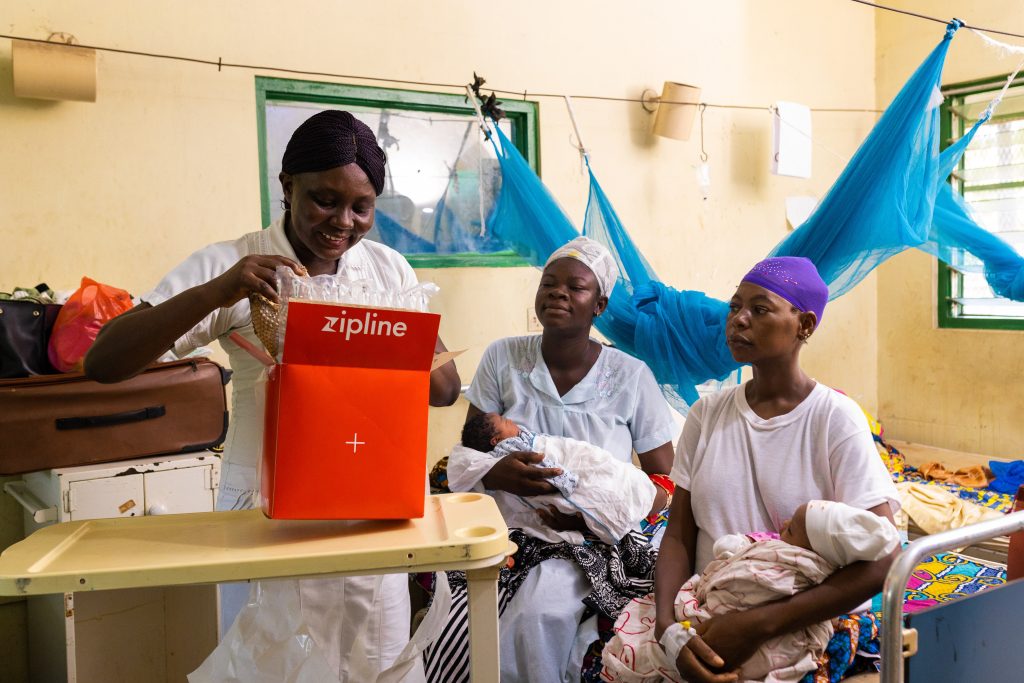
The most consequential finding involves ready-to-use therapeutic food, or RUTF, the standard treatment for severe acute malnutrition in children. The treatment only works if clinics have continuous supply — and rural facilities frequently run out, interrupting care.
By comparing 299 facilities served and not served by Zipline drones over five years, researchers found in-hospital deaths from severe malnutrition fell 22 percent at served facilities, alongside steep drops in malnutrition encounters across age groups.
Notably, hospitalizations actually rose 21 percent — which the study interprets as clinics catching more cases earlier and sustaining treatment that previously stalled.
That interpretation is plausible, but it’s also the kind of finding that benefits from independent replication.
A rise in hospitalizations paired with a fall in deaths is consistent with better case detection — it’s also consistent with shifts in referral patterns or reporting practices that have nothing to do with drone logistics. The study doesn’t appear to have ruled out alternative explanations for why served and non-served facilities might differ in other ways.
Pig Semen and a 68 Percent Return
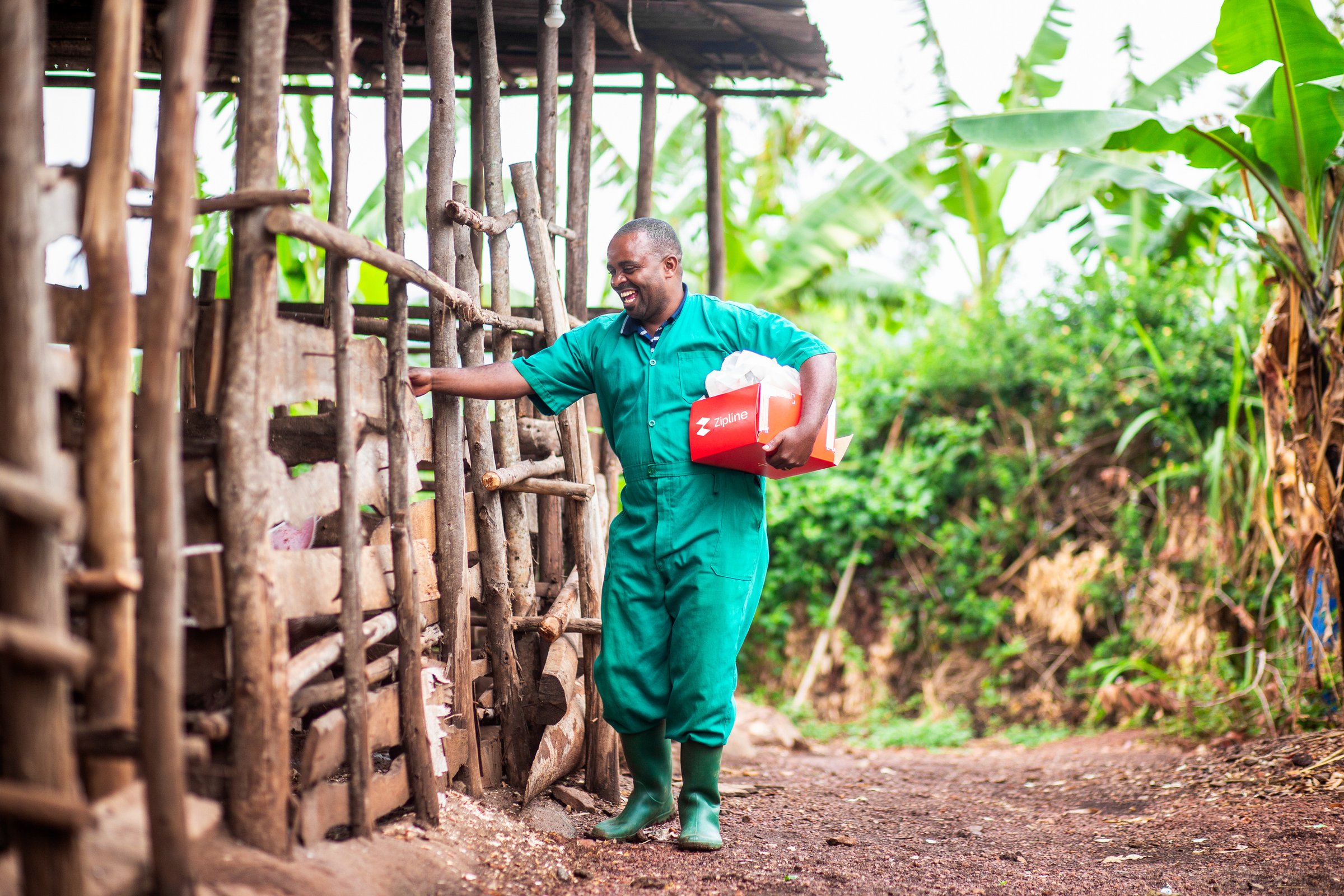
In Rwanda, Zipline partnered with the government’s agriculture board to deliver pig semen for artificial insemination to smallholder farmers across eight districts, paired with training for community animal health workers.
The peer-reviewed study, published in Frontiers in Veterinary Science, found that insemination success rates climbed from roughly 49 percent to 75 percent, and that the program generated nearly $129,000 more in farmer income than it cost — attributing 17 percent of farmers’ income gains directly to Zipline’s involvement.
Peer review lends this study more credibility than the others, though the 17 percent attribution figure is doing a lot of work. Isolating Zipline’s specific contribution from concurrent training programs, government extension efforts, and broader agricultural trends is methodologically difficult, and the paper’s framing — emphasizing the return-on-investment figure as a headline number — suggests it was written with an eye toward justifying continued funding as much as toward rigorous causal isolation.
An economy “visible from space”
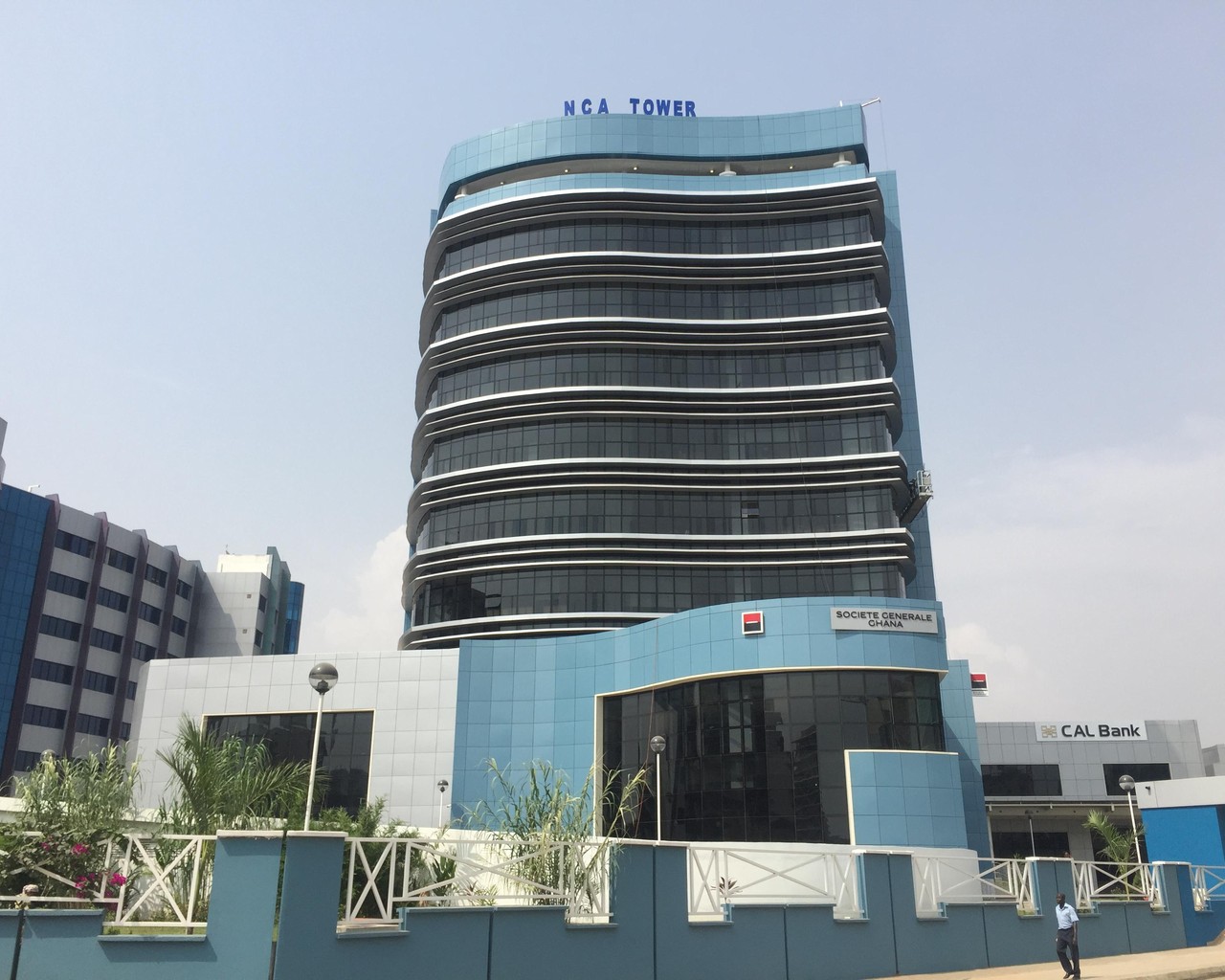
The most ambitious claim comes from Ghana, where researchers paired household surveys with satellite imagery of nighttime light intensity around Zipline’s GH3 distribution hub in the country’s north, benchmarked against 82 comparable locations.
Households within two kilometers of the hub reported $850 to $1,200 in additional annual income, alongside better water access and higher rates of liquid-asset accumulation that declined with distance from the hub.

Nighttime-light analysis is a well-established proxy for economic activity, and the distance-decay pattern — benefits shrinking the farther a household sits from the hub — is the kind of result that’s harder to wave away than a single survey statistic.
But correlation and causation are difficult to separate in this design. Zipline doesn’t site its hubs randomly; it chooses locations based on existing infrastructure, road access, and population density — all factors that independently predict economic activity. A hub built near a town that was already on an upward trajectory could produce exactly this pattern without the drones contributing much at all.
What the research actually tells us
None of this means Zipline’s network isn’t useful — reliable delivery of medical supplies to rural clinics is, on its face, a good thing, and the malnutrition findings in particular align with what logistics economists would predict from reducing stockouts.
But the broader economic narrative — that drone delivery hubs are visible engines of local prosperity — rests on studies that were largely initiated or funded with Zipline’s strategic interests in mind, at a moment when the company is seeking to expand beyond healthcare into agriculture, retail, and e-commerce delivery across Africa.
For governments weighing whether to expand drone-logistics contracts, and for the development funders who increasingly co-finance them, the honest takeaway is that Zipline appears to be solving a real supply-chain problem in places where conventional logistics fail.
Whether that translates into the broad economic transformation the company is now promoting is a claim that would benefit from research conducted at arm’s length from the company itself.