




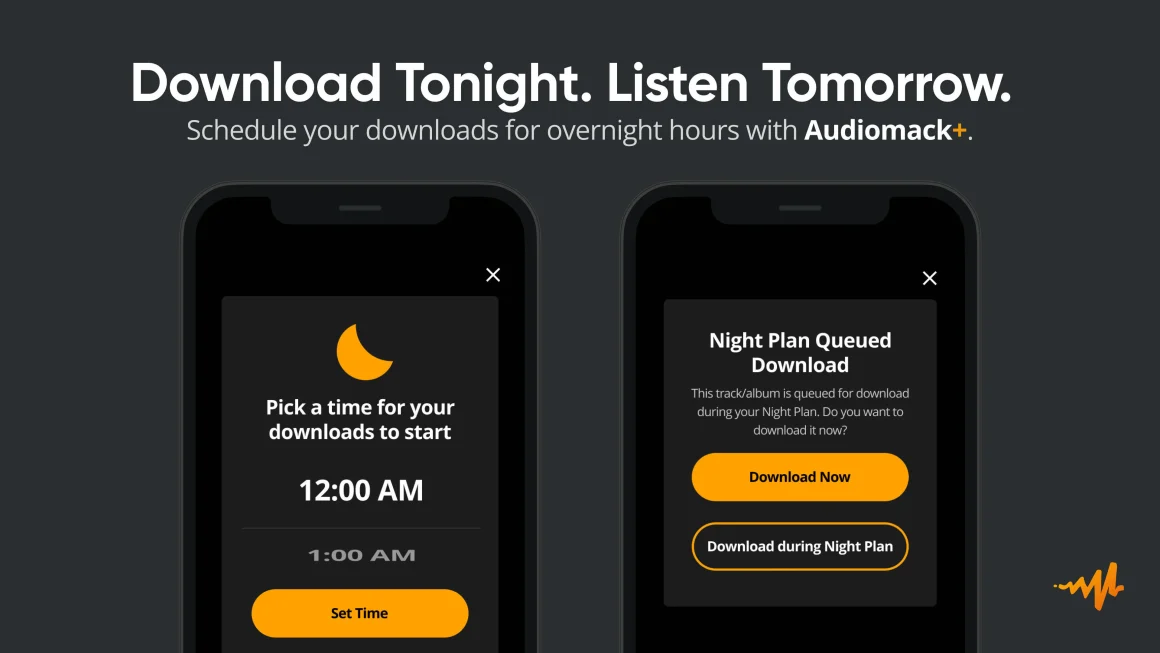
Audiomack has introduced Night Plan, a feature that lets subscribers schedule music downloads for overnight hours, when mobile data is often cheaper across several African markets. The launch targets a persistent obstacle to streaming growth on the continent: the cost of the data itself.
How it works
Night Plan is available to Audiomack Plus subscribers. Users queue songs during the day, and the app downloads them later, during discounted overnight windows on supported carriers, including MTN, Airtel, Glo, and 9mobile.
A moon icon marks Night Plan status in the download queue, and notifications track progress. If a scheduled download is delayed more than four hours, the app skips it and tries again the following night.
The design is deliberately low-effort for users. Rather than asking listeners to change habits or monitor data usage manually, the feature works passively in the background.
Betting on existing behavior, not new habits
Audiomack has built its African strategy around adapting to how people already use their phones rather than pushing them toward new patterns. Co-founder and CMO David Ponte framed Night Plan as an extension of that approach. “Streaming services need to embrace these differences and support fans, not try to change them,” he said, according to the company.
That strategy has coincided with rapid growth. The company says it has recorded 109.3 billion plays and 16.3 billion offline downloads across Africa since 2020, and ranks as the top music app in more than 21 countries on the App Store and Google Play — a figure that has grown from the 11 cited in Audiomack’s Night Plan announcement, suggesting continued momentum. These numbers come from the company itself and are not independently verified.
Carrier partnerships underpin the model
Night Plan builds on a broader web of telecom partnerships Audiomack has cultivated across the continent. The company’s relationship with MTN Nigeria dates to 2021, when it launched a data-bundle program for MTN’s subscriber base before expanding into tiered Audiomack+ subscriptions offered directly through the carrier. Deals with Africell Gambia and Orange Liberia extend the same model to smaller markets.
This carrier-integration strategy — bundling music access directly into mobile data plans — has become one of Audiomack’s clearest differentiators from global rivals. Spotify and Apple Music largely rely on credit-card-based subscriptions, which limits their reach in markets where card penetration is low.
Audiomack, along with Transsion-backed rival Boomplay, has instead built distribution around prepaid mobile data and free, ad-supported tiers — a model better suited to how most African listeners actually pay for connectivity.
A crowded but growing market
Audiomack’s expansion arrives as Sub-Saharan Africa has become one of the fastest-growing streaming markets globally, with the IFPI’s most recent Global Music Report noting a sharp rise in regional paid-subscription adoption.
Audiomack and Boomplay have emerged as the two dominant players shaping how African listeners and artists engage with streaming, with each carving out a distinct niche: Boomplay leaning on deep regional catalog and local chart relevance, Audiomack building its reputation on discovery and viral reach for emerging artists.
Night Plan doesn’t change Audiomack’s underlying business model — it remains free-to-access, monetizing through advertising and the ad-free Audiomack+ tier. Instead, it addresses a narrower but persistent friction point: the cost of the data pipe itself, which Audiomack does not control but is now working around.
Whether Night Plan meaningfully shifts listening patterns — or simply formalizes a workaround many users already employ manually — will depend on adoption data Audiomack has yet to share.