




Ghana’s fiber broadband network is getting dramatically faster, but it remains a small, urban story in a country where mobile internet dominates.
New research from Ookla shows Ghana posted the broadest download speed gains among six West African markets studied between 2023 and mid-2026. Yet fiber subscribers still represent less than 1 percent of the population, exposing a stark divide between network quality and network reach.
A Sudden Leap in Speed
Ghana’s median fixed broadband download speed rose 69 percent between 2023 and the first half of 2026, climbing from 31.17 Mbps to 52.78 Mbps. The slowest connections improved even faster: the bottom 10th percentile of speeds more than doubled, from 3.03 Mbps to 7.13 Mbps.
The most dramatic shift came in a single quarter. In the third quarter of 2025, median upload speed jumped from 22.60 Mbps to 49.16 Mbps, and latency dropped from 34.6 milliseconds to 12.6 milliseconds. Ookla attributes the leap to the growing share of fiber connections, which offer symmetrical upload and download speeds unlike older broadband technologies.
The recent landing of Meta-backed 2Africa subsea cables in Accra is expected to add further capacity, potentially improving performance again in coming quarters.
A Market of Two Operators
Ghana’s fixed broadband sector is a duopoly. MTN and Telecel control the market, according to the National Communications Authority, which counted 261,938 fiber subscribers in the fourth quarter of 2025 — up 18.4 percent from a year earlier. Fixed wireless access, by comparison, accounts for fewer than 1,500 connections nationwide.

That growth looks strong in percentage terms but starts from a small base. Ghana had 42.87 million mobile subscriptions as of the same period — a penetration rate of 127 percent. Fiber’s reach, by contrast, is confined mostly to urban and suburban pockets, limiting how much of the population can benefit from the speed gains Ookla documented.
Limited competition is part of the story. With only two major fiber providers, Ghana lacks the kind of multi-operator, infrastructure-sharing push seen in neighboring markets.
How Ghana Compares Regionally
Ghana’s trajectory sits in the middle of a region moving at different speeds. Nigeria posted the most consistent quarter-over-quarter improvement, with median download speeds rising 2.55 times to 34.47 Mbps as fiber subscribers roughly tripled between late 2024 and June 2026. Côte d’Ivoire had the fastest median speeds overall, reaching nearly 61 Mbps, though gains for its fastest users have plateaued.
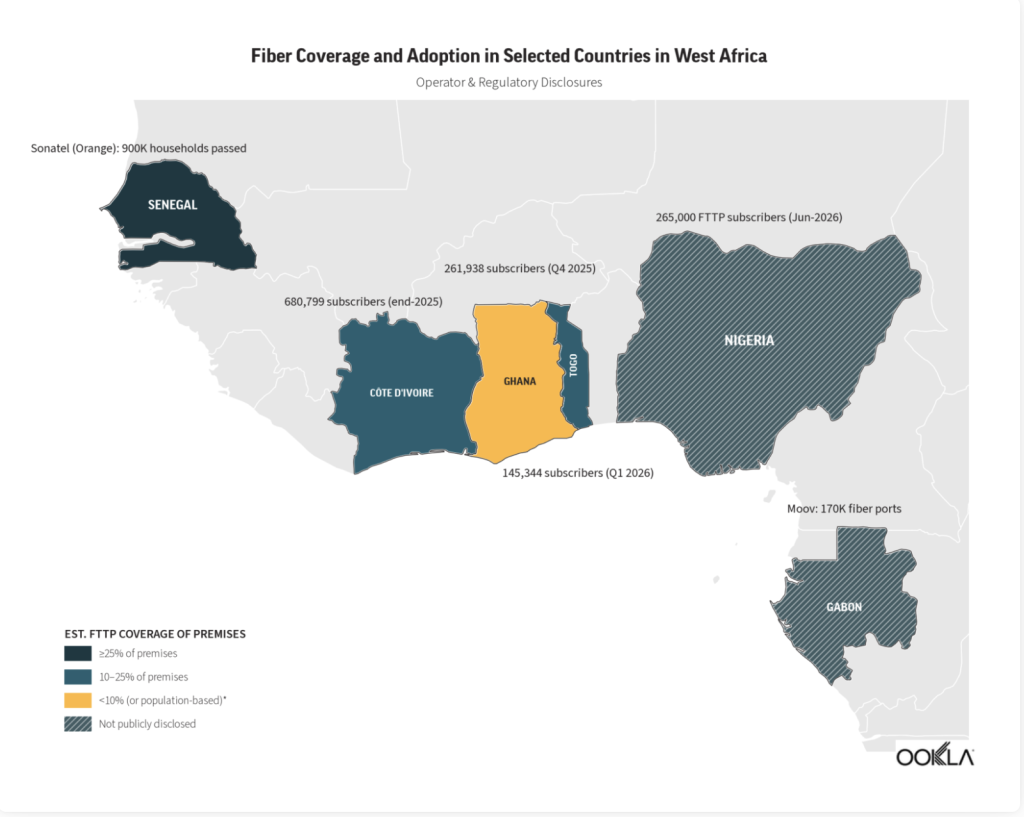
Senegal saw slower long-term growth but a sudden acceleration in 2026, after dominant operator Sonatel overhauled its residential fiber pricing and speed tiers in February. Smaller markets Togo and Gabon are earlier in their fiber build-outs, with progress there driven more by regulatory intervention than organic demand.
Unlike Côte d’Ivoire, which is layering in 5G and satellite-based coverage for rural areas, and Nigeria, where regulators are pushing operators to share infrastructure and cut right-of-way fees, Ghana’s public strategy for closing its urban-rural gap is less defined in the Ookla research.
The Satellite Wildcard
Traditional ISPs across the region also face a new competitor: Starlink. SpaceX’s satellite service is now licensed in more than 28 African countries and has an estimated half a million subscribers on the continent, with Nigeria alone accounting for over 66,000 as of mid-2025. Starlink is already available in Ghana, offering an alternative for customers outside fiber’s urban footprint.
Some operators elsewhere in the region have responded by partnering with satellite providers rather than competing with them. Orange Côte d’Ivoire and Sonatel in Senegal have both launched hybrid satellite-fiber products aimed at rural customers. Ookla’s report does not indicate a similar move yet from MTN or Telecel in Ghana.
What It Means
Ghana’s numbers tell a familiar story for African broadband markets: fast improvement where fiber already exists, and a widening gap for everyone else. Whether that gap narrows will depend on whether Ghana’s regulator and its two dominant operators expand coverage beyond cities — or whether satellite providers fill the space instead.