




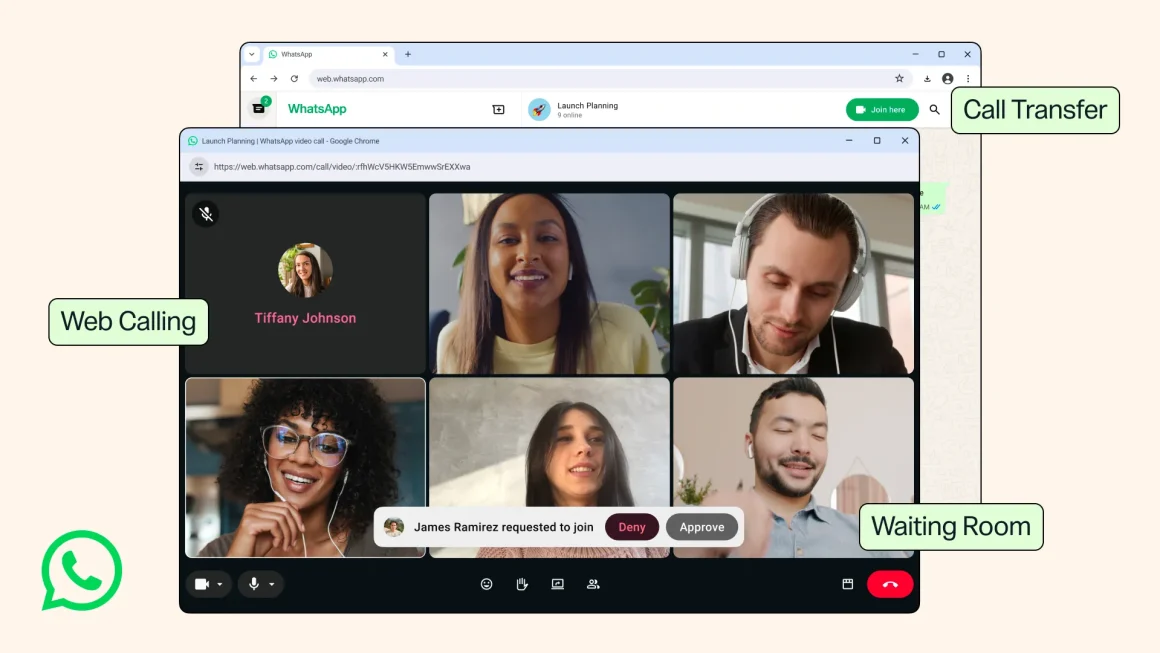
WhatsApp is finally letting people call each other from a web browser. Until now, that feature was limited to the mobile app and WhatsApp’s standalone desktop program. Meta, which owns WhatsApp, is rolling the capability out to WhatsApp for Web starting this week.
What’s Changing
The web version will get its own Calls tab, mirroring what’s already in the desktop and mobile apps. That tab keeps a log of call history and a list of favorite contacts. Users will also be able to share their screens and send reactions during calls, features that were previously exclusive to the desktop app.
The update effectively closes a long-standing gap between WhatsApp’s browser experience and its dedicated apps. For years, people who preferred working entirely out of a browser had to switch to their phones or install separate software just to make a call.
Call Transfers Between Devices
Alongside the browser rollout, WhatsApp is introducing a feature that lets users move an ongoing call from one device to another without hanging up. Someone who starts a conversation on a laptop, whether through the web app or the desktop program, can pick it up on their phone mid-call.
This kind of handoff is common in other communication tools, but it has not previously been part of WhatsApp’s offering.
Waiting Rooms for Group Calls
Meta is also adding host controls aimed at group calls, a feature that could matter to businesses using WhatsApp for meetings. Anyone creating a call link can now turn on an “Require approval to join” setting, which places new arrivals in a waiting room. The host decides when to let someone in, and can also remove participants once they’ve joined.
That gives hosts more control over who accesses a call, particularly useful for calls where the link might circulate beyond the intended group.
Audio and Video Quality Improvements
Two other changes focus on call quality. WhatsApp is adding background noise suppression, intended to filter out ambient sound when someone is calling from a crowded or noisy location.
The company also said video calls will now switch to high-definition faster. Previously, calls often opened at lower resolution for the first several seconds before adjusting to HD.
Part of a Broader Push
The changes follow Meta’s recent move to open up reservations for WhatsApp usernames, a feature still in the process of rolling out. Once usernames are fully live, the company has said they’ll let people call each other without exchanging phone numbers, and eventually across platforms.
Taken together, the updates point to WhatsApp positioning itself less as a purely mobile messaging app and more as a full communication platform that competes with tools like Zoom, Microsoft Teams and Google Meet, particularly for group and business calls, where waiting rooms and screen-sharing matter most.
What’s Missing
Meta’s announcement doesn’t specify a timeline for when the calling features will reach all WhatsApp for Web users, or whether the rollout will happen in phases by region.
It’s also unclear whether the noise suppression and faster HD switching apply to the mobile and desktop apps, or if those improvements are exclusive to certain platforms.