



WhatsApp is quietly testing a fix for one of its most persistent annoyances: the flood of business messages that bury personal conversations.
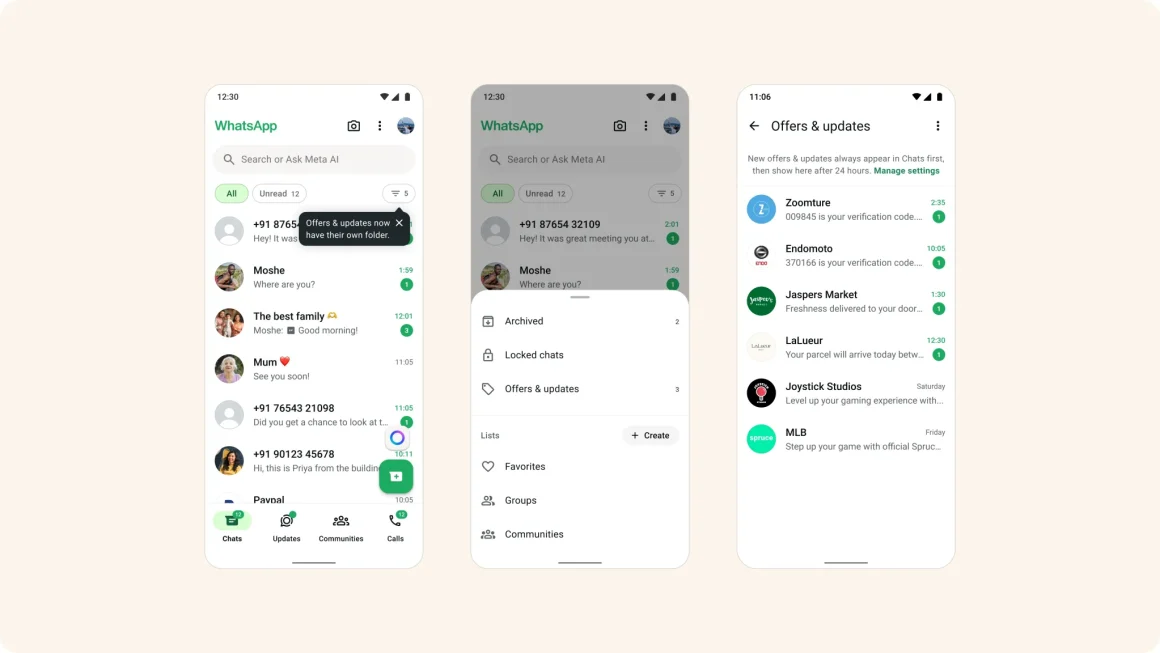
The Meta-owned app is piloting a new “Offers & Updates” folder that will automatically sort messages from large businesses — banks, airlines, delivery services — out of the main chat timeline. Messages will move to the folder after a set delay, with Meta testing windows of up to 24 hours, TechCrunch has learned exclusively.
A Side Effect of Meta’s Messaging Business
The feature arrives just as WhatsApp’s commercial ambitions are paying off. During Meta’s second-quarter earnings call, chief executive Mark Zuckerberg said other revenue in the family of apps segment surpassed $1 billion, driven largely by WhatsApp’s paid messaging and subscription products.
That growth has a cost for users. As more companies lean on WhatsApp to reach customers, inboxes have become harder to navigate, with promotional messages, delivery alerts and customer service pings crowding out messages from friends and family.
How the Folder Would Work
Under the new system, messages from large businesses would be swept into the separate folder automatically, without requiring users to opt in. Users who prefer to keep everything on one timeline can disable the feature entirely, but they won’t be able to control the specific timing of when messages get moved.
Meta says the goal is to make time-sensitive but low-priority messages — discount codes, delivery notifications — disappear from the main inbox within hours, while giving businesses a dedicated space where customers know to look for updates.
The test is currently limited to select partners on the WhatsApp Business Platform. Small businesses and individual accounts using WhatsApp Business are exempt for now, though the company said it may eventually extend the folder to those senders as well.
Part of a Longer Cleanup Effort
This isn’t WhatsApp’s first attempt to rein in business messaging. In 2024, the app began letting users unsubscribe from marketing messages. Last year, it capped the number of broadcast messages businesses and individuals could send within a given period. Then in October 2025, WhatsApp went further, limiting how many messages businesses could send without getting a response from the recipient.
The first two measures have fully rolled out. The response-based limit is still being refined.
Despite the changes, many users say their inboxes remain overwhelming. Business communications routinely make up a large share of unread messages, and complaints about inbox clutter are common on social media.
The new folder may ease some of that burden, but it stops short of giving users direct control over which messages get filtered — a limitation that could blunt its impact.
AI Agents Add a New Wrinkle
The clutter problem is likely to intensify as WhatsApp pushes further into AI-driven business messaging. The company made its AI business agents available globally in June, and more than 1 million businesses have already adopted them.
Zuckerberg cited Movida, a Brazilian car rental company, as an early success story, saying the company has seen higher conversion rates and faster customer support resolution using AI agents on WhatsApp.
As more businesses deploy AI for sales, marketing and support, the volume of automated messages reaching users is likely to grow. For a platform with more than 3 billion users, that raises a central challenge: keeping WhatsApp a place for personal conversation, rather than letting it become another inbox dominated by automated pitches.