






SpaceX filed its S-1 with the SEC on May 20, 2026. Most of the attention will fixate on rockets, Elon Musk’s voting control, and the sheer audacity of a $1.75 trillion valuation.
But bury past the cover page and a clearer picture emerges: this is, at its financial core, a satellite internet company going public.
Starlink — the low-Earth orbit broadband constellation SpaceX has been quietly building since 2019 — is the engine underneath everything. And by almost any measure, it’s one of the fastest-growing consumer technology businesses in history.
From Side Project to Cash Machine
The numbers tell a story of compounding momentum. Starlink subscribers doubled from 2.3 million at the end of 2023 to 4.6 million at end of 2024, then doubled again to 9.2 million through the end of 2025.
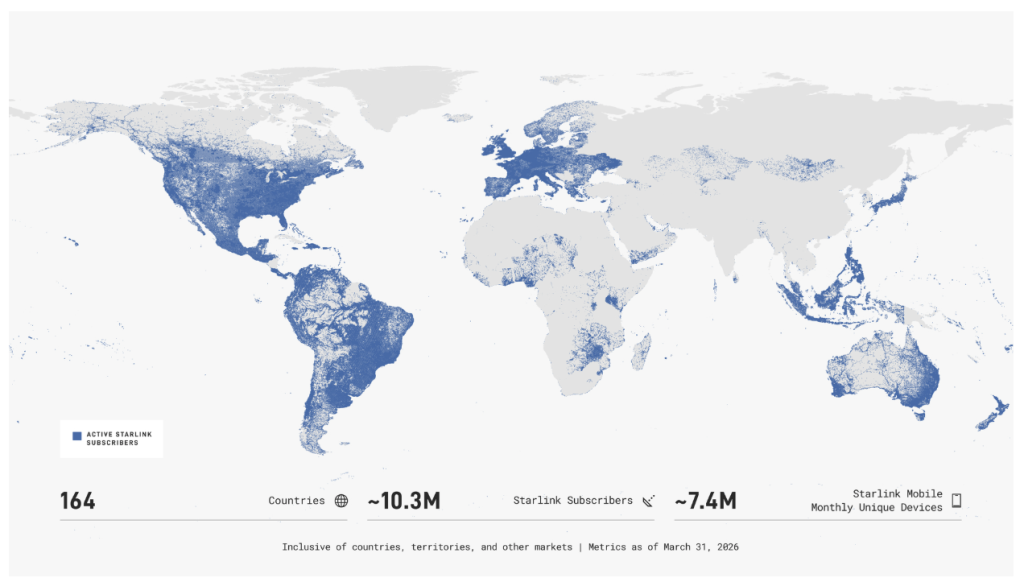
By February 2026, Starlink had surpassed 10 million active customers across 160 countries, territories, and markets.

The revenue trajectory matches. Starlink accounted for $11.4 billion of SpaceX’s revenue in 2025 — up 83% year-over-year from $7.7 billion in 2024, and comprising the dominant share of total company revenue. Analysts at Quilty Space project that figure climbs to roughly $20 billion in 2026, accounting for approximately 79% of SpaceX’s total revenue for the year.
What makes this unusual isn’t just the growth rate — it’s the margins. Starlink’s EBITDA reached $7.2 billion in 2025, with an adjusted margin as high as 63%. For a capital-intensive infrastructure business deploying satellites at scale, that’s a remarkable number.
A Constellation Like No Other
The S-1 prospectus discloses that SpaceX operates approximately 9,600 Starlink broadband and mobile satellites in Low-Earth Orbit — roughly 65% of all active satellites globally as of late April 2026.
It’s the product of SpaceX’s vertically integrated model: the company that builds the rockets also builds the satellites and launches them at a cost no competitor can match.
The next phase is already loaded. The S-1 confirms that V3 satellites — each carrying one terabit per second of downlink capacity — are scheduled to begin deployment on Starship in the second half of 2026. That’s a step-change in network throughput, and it arrives just as subscriber growth is accelerating.
Beyond Home Broadband
Starlink’s residential broadband business gets the most attention, but the more lucrative opportunity is in segments that have barely been touched. In maritime, Starlink commands approximately $34,000 in average annual revenue per user; in aviation, that figure rises to around $300,000 — both segments where the company holds less than 1% market share today.
Then there’s Starshield — SpaceX’s government-grade satellite network for defense and intelligence customers. A $537 million contract with the U.S. Department of Defense runs through 2027, and analysts at Quilty Space expect Starshield to contribute $3.2 billion in revenue by 2026.
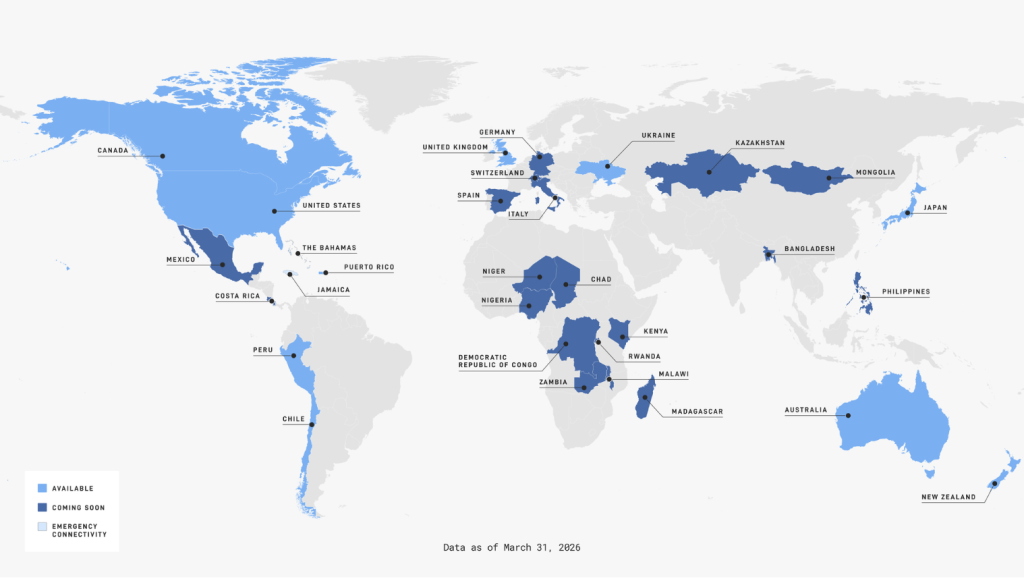
And the newest frontier: satellite-to-mobile, a service that beams connectivity directly to standard smartphones without any additional hardware. The S-1 confirms coverage in approximately 30 countries, with monthly active users already surpassing 10 million and projected to exceed 25 million by end of 2026.
The ARPU Trade-Off
Not everything in the prospectus is unambiguously bullish. Average revenue per subscriber fell 18% to $81 per month between 2023 and 2025, even as the individual subscriber base quadrupled — a deliberate trade of pricing power for global volume.
SpaceX is betting that the subscriber base grows fast enough to more than compensate for the compression. So far, that bet is working. Whether it continues to hold as the service penetrates lower-income markets remains one of the key uncertainties heading into the IPO.
The Infrastructure Bet Hiding in Plain Sight
Zoom out further, and Starlink starts to look less like a broadband provider and more like a piece of critical global infrastructure. The S-1 notes delivery to consumers, enterprises, and governments across 164 countries and territories.
In many of those markets — particularly across sub-Saharan Africa, Southeast Asia, and rural Latin America — Starlink is often the only viable high-speed internet option available.
That positioning gives SpaceX pricing durability and political relevance that most tech companies can only dream of. Governments don’t cancel their internet infrastructure.
SpaceX targets a June 12 listing on Nasdaq under the ticker SPCX, aiming to raise $75 billion. At that scale, it would be the largest IPO in U.S. history.