




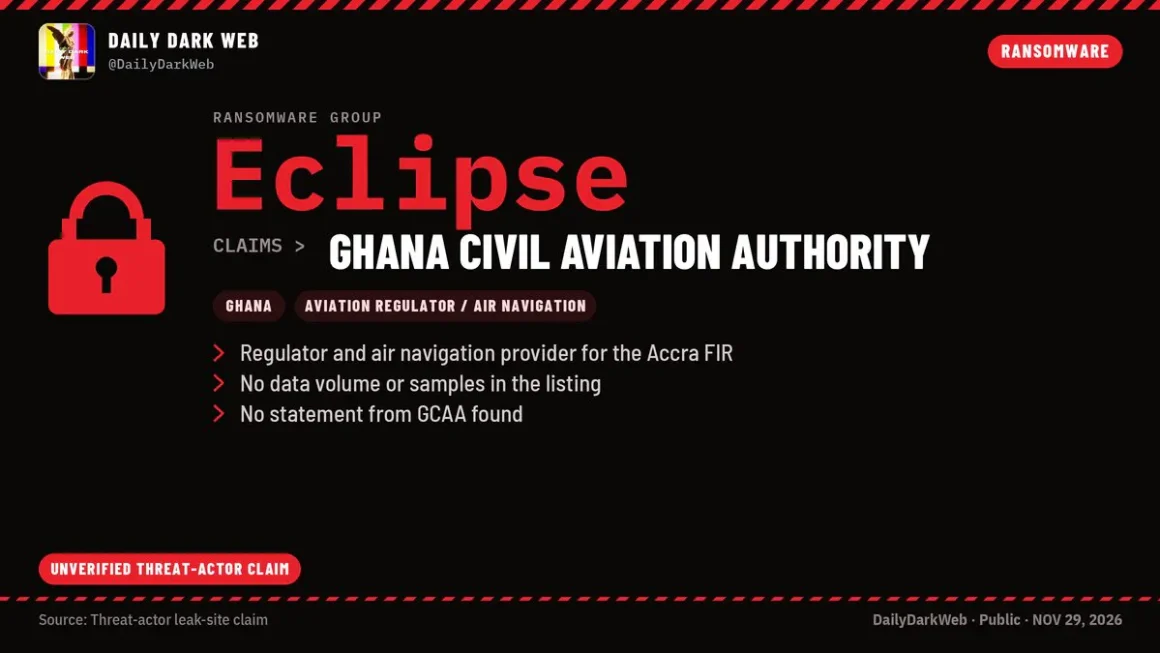
A ransomware group called Eclipse says it has attacked the Ghana Civil Aviation Authority, the country’s aviation regulator. The group posted the agency on its dark web leak site this week.
The listing does not say what data was taken or how much. No samples have been published. The authority has issued no statement, and no reputable outlet has reported a breach. Nobody has independently confirmed the claim.
What the Authority Does
The Ghana Civil Aviation Authority, known as GCAA, was established in 1986. It regulates air transport, licenses air operations, oversees aerodrome management and provides air navigation services within the Accra Flight Information Region. That airspace covers Ghana and a large part of the Gulf of Guinea.
A regulator like this holds sensitive material. That includes operator licensing records, safety oversight files, personnel certifications and air navigation data. If the claim is true, airlines, airports and licensed aviation staff could be affected.
Who Is Eclipse?
Eclipse is new, and public information about it is thin. Threat trackers list 2026 as its first year of activity. In October, a user known as EclipseSupport began promoting it on cybercrime forums as a ransomware-as-a-service product, meaning the developers rent the tools to affiliates.
The malware targets Windows, Linux and VMware ESXi systems, and the operators use double extortion, which means stealing data and threatening to publish it if victims do not pay. The group says it encrypts files with ChaCha20 and uses Kyber, a post-quantum scheme, for key exchange.
Its known victims are mostly outside Africa. In the 60 days before an October listing, security firm SOCRadar counted 11 claimed victims across India, Singapore and the United States, mainly in technology and hospitality. On October 8, the group claimed an attack on Global AirFreight International, a Singapore logistics company.
Trackers disagree on the group’s scale. Breachsense, as of mid-August, had recorded a single victim. SOCRadar’s profile lists 19. That gap is typical for a young group whose leak site is hard to monitor.
Why Leak-Site Claims Need Caution
Ransomware groups have a financial incentive to exaggerate. A listing pressures a victim to negotiate whether or not the data is valuable. Security firms note that leak-site listings often cannot be independently verified and may not reflect confirmed breaches.
Groups also sometimes post old or already public data as new. Until Eclipse publishes samples, or GCAA confirms an incident, this is a threat-actor claim and nothing more.
Ghana’s Wider Cyber Picture
Ghana has had a rough year online. The Cyber Security Authority recorded 4,938 incidents from January to September 2026, against 4,604 for all of 2025. Reported losses reached GH¢209.7 million, nearly ten times the 2025 figure. Most reported cases involve fraud, not ransomware.
State bodies have been hit before. In October 2024, the BlackSuit group attacked the Volta River Authority, the country’s main power producer. Last month, the Cyber Security Authority and the National Information Technology Agency gave government agencies seven days to fix critical flaws that could let attackers take over their servers.
Ghana’s directive on critical information infrastructure, launched in October 2021, requires owners to run risk assessments, report incidents and keep response plans. An air navigation provider would normally fall under that framework. Whether the directive was followed here is unknown.
What Happens Next
Eclipse’s listing usually includes a deadline, after which the group publishes what it holds. If samples appear, the claim can be checked. If GCAA stays silent and no data surfaces, the claim may fade without resolution.
The authority has not responded to the listing. Ghanaian law and the critical infrastructure directive both push operators toward reporting serious incidents, so a statement would not be unusual.