




ACCRA, Ghana — For years, Ghana positioned itself as West Africa’s calmer alternative to Nigeria: fewer regulatory surprises, a more predictable currency, a friendlier home for fintech.
But recently, Ghana’s technology ecosystem has been hitting some headwinds and navigating rocky terrain.
The unraveling of Zeepay, one of the country’s best-known mobile money companies, has become a cautionary tale. Startup funding, meanwhile, has slowed considerably compared to previous years.
Advancements like the growth of AI and Ghana’s Virtual Assets bill have been notable. But the implementation of these technologies will take a while to manifest and become more known to the average Ghanaian consumer.
With record funding highs in its past year, has Ghana’s tech ecosystem matured, or has it simply hit its ceiling and stopped growing?
The Zeepay Collapse
Zeepay, as recently as last September, was a Ghanaian success story with more chapters to be written. The company closed a $22 million Series B, adding to more than $50 million raised over its history, and operations spanning multiple markets including Barbados and Nigeria.
Ten months later, its regulatory license was gone.
On July 14, the Bank of Ghana revoked Zeepay’s electronic money license, saying the company had issued mobile money without holding the cash reserves required to back it — a shortfall regulators called a “negative variance.”
The central bank said Zeepay had ignored repeated directives to fix the problem and posed a “direct threat” to the payment system.
The revocation capped a string of setbacks. In April, Ghana’s High Court ordered Zeepay and its founder, Andrew Takyi-Appiah, to personally pay more than $11.6 million to a customer whose funds were never transferred — after evidence showed some of the money had landed in the CEO’s own mobile wallet.

A separate creditor had already petitioned to wind up the company over an unpaid $1.2 million debt. In May, regulators in Barbados suspended a Zeepay subsidiary. By August, a Ghanaian court had frozen all of the company’s assets pending a full winding-up case.
The Digital Chamber, an industry group representing licensed payment providers, urged the market not to read Zeepay’s troubles as a verdict on the whole sector.
Funding Has Not Kept Pace
Even without the Zeepay saga, Ghana’s startups are raising less money than previous years.
Ghanaian companies closed an estimated 38 disclosed deals worth $127 million in 2024 — a 22 percent rise in dollar volume from 2024, but a 9 percent drop in the number of deals.
However, in 2025, funding dropped to $90 million.
The early data for 2026 is weaker still. The first quarter brought just six disclosed deals totaling $18 million, an annualized pace of roughly $72 million — below 2025’s total.
Estimates suggest that the ecosystem raised between $27 to $31 million in the first half of 2026.
Investors cite familiar headwinds: higher U.S. interest rates, thin appetite among global limited partners for frontier markets, and a general retreat from early-stage risk.
No Ghanaian startup has reached unicorn status yet. mPharma, the health-tech company often mentioned as the closest contender, has been in Series D talks reportedly valuing it between $400 million and $500 million.
Maturing or Stalling?
It’s too early to determine what the numbers mean.
On one hand, the data could signify that Ghana’s market is “maturing”. Fewer, larger deals suggest investors are backing companies with real traction rather than spreading small checks across untested ideas.
Regulators cracking down on companies like Zeepay, in this view, shows a central bank willing to enforce rules rather than look away as companies scale.
The other reading is less comfortable. A funding pace cut in half, a marquee fintech in receivership, and a decade without a single unicorn could point to a market that has hit a ceiling.
Africa’s broader tech downturn — funding across the continent fell from a 2022 peak of $4.65 billion to roughly $2.2 billion by 2024 — has not spared Ghana, and the country’s own regulatory shocks have added a local drag on top of the regional one.
Stalled Startup Bill and Legislation Controversies
With tech regulation, one thing that stands out is Ghana’s startup bill.
The bill was first drafted in January 2020, under the previous government. It was proposed as a legal framework that would formally define what a “startup” is in Ghana.
The bill stalled for years after that initial draft. The new administration revived it in early 2025, with Communications Minister Samuel Nartey George taking it up. He announced plans to present it to Parliament, with stakeholder consultations across Ghana’s regions.
Fast forward, and there haven’t been any new updates on the bill’s status. This could signal that the bill will more likely be taken up again in 2027, seven years after its initial draft.
In addition to Ghana’s startup bill, the ecosystem has also faced controversy with new legislation.
Earlier this year, bills like the National Information Technology Authority (NITA) Bill, 2025 stirred up a lot of industry players. It was a draft ICT regulatory law, covering ICT infrastructure installation, ICT products and services, and anything requiring licensing or certification in the digital space.
The pushback caused the Minister of Communications to convene a meeting with industry players to help smooth over issues.
What’s Next for The Ecosystem
What’s the next evolution for Ghana’s tech ecosystem?
At the moment, there’s been a lot of discussion about Artificial Intelligence. Google has stepped up its efforts in the space, opening its AI Community Center in Accra earlier in the year.
The government has also been pushing for AI use in public service, including its ports.
But moves to use “foreign” companies instead of homegrown AI talent have caused backlash from ecosystem players who felt left out.
As the usage of AI grows, will more local players like legal AI startup Kwame AI and Khaya be enlisted, or will contracts keep going to external companies?
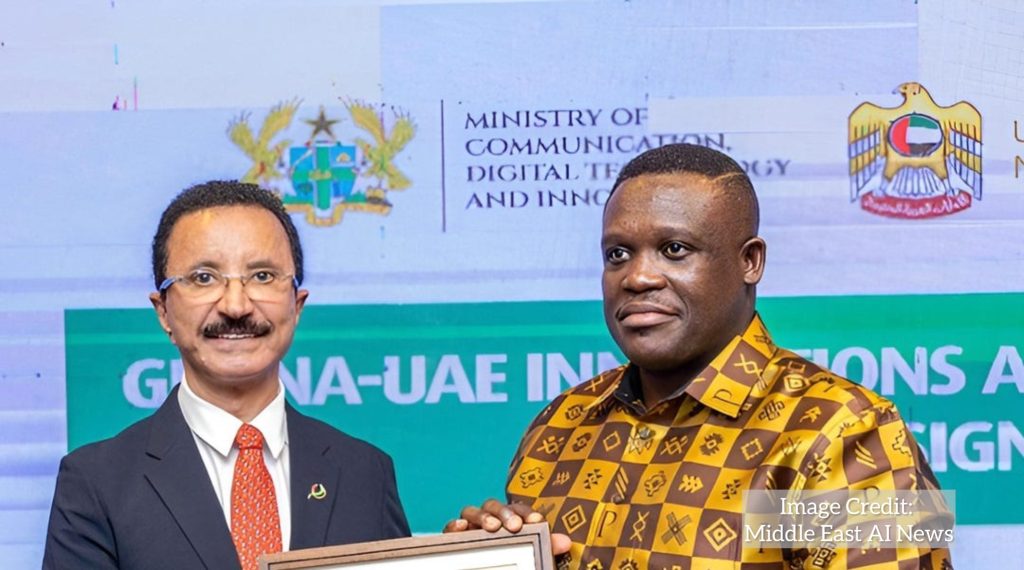
The launch of the Ghana National AI strategy has been welcomed by many, especially on the continent. But since the announcement of an MOU agreement with a UAE company named PCFC to build a $250 million AI compute last year, not much has materialised.
News of the resignation of the company’s chairman due to Jeffrey Epstein ties did not make local news. There has been no official update on the MOU agreement between the chairman’s firm and the Ghana government to construct the center in the fourth quarter of this year.
Our data at Tech Labari still shows that fintech is still the leading space in the ecosystem. However, clean tech like electric vehicles is becoming more popular, with companies like BYD, Arc Ride, and Kofa making moves to integrate into Ghana’s space.
There are some areas left to innovate, especially in agriculture and health.
There are four months left in 2026. As the year draws to a close, there’s still time for companies to announce funding rounds or other related news, which might show that the ecosystem is growing.
Ghana’s ecosystem can be seen as an enigma, or a mystery, with some players working mostly in silos, compared to other technology ecosystems. With the EV tech space showing signs of growth, fintech still dominant, and AI occupying all the news stories, it might be hard to predict what will happen in 2027 for Ghana’s tech space.